

If you have seen Christopher Nolan’s famous Interstellar, you’ll know when Cooper falls into Gargantua, enters the fifth dimension, and somehow, through a wormhole, returns near one of Saturn’s satellites and survives, but could a real human survive a similar fall? In today’s blog, we’ll explore what happens to your body when you fall into a supermassive black hole. Will your body stretch like noodles, will your age go by slowly compared to Earth, or will you fall to the core of the black hole?
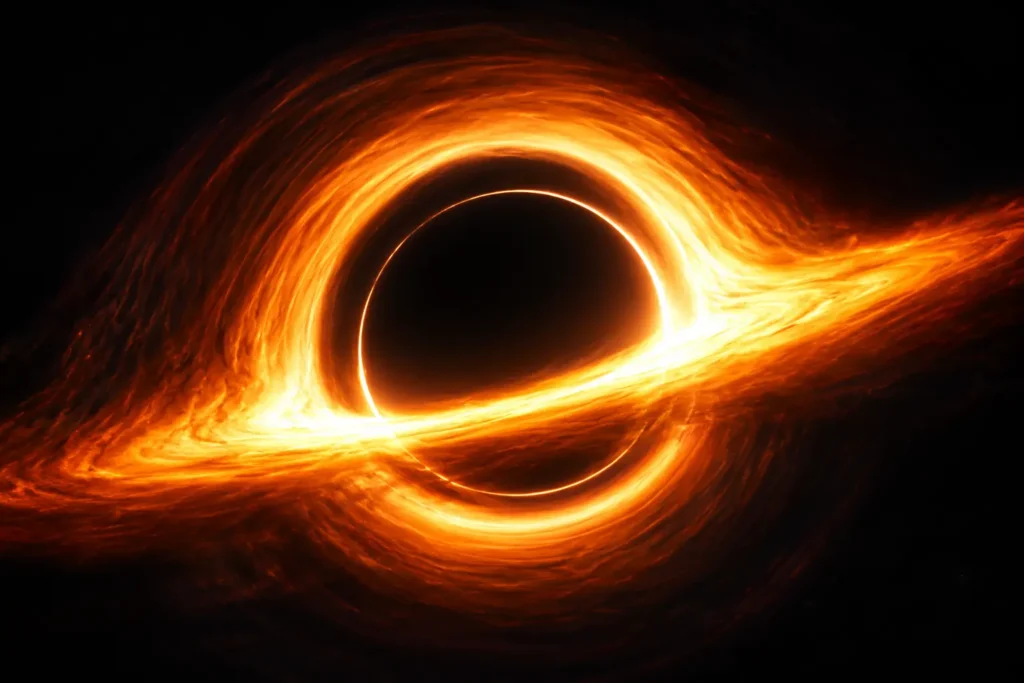
What Happens If You Fall Into a Supermassive Black Hole?
Imagine falling toward a supermassive black hole, one of the most extreme objects in the universe. As you approach, its gravity bends light from distant stars, creating a strange and distorted view of space. Eventually, you reach the event horizon, the boundary beyond which nothing can escape, not even light.
Surprisingly, crossing this boundary would not necessarily kill you instantly. Unlike smaller black holes, supermassive black holes can have relatively weak tidal forces at their event horizons. If you were falling freely and the surrounding environment were safe, you might cross without feeling a sudden impact.
However, surviving the crossing does not mean escaping the black hole. Once inside, no spacecraft or communication signal could return to the outside universe. As you continued falling inward, increasing tidal forces could eventually stretch and destroy your body.
Scientists still cannot fully explain the extreme conditions predicted at a black hole’s center. One thing is clear: the event horizon marks the point of no return, not necessarily the moment of death.not necessarily the point where a human body is immediately destroyed.
1. What Is a Black Hole, and How Does It Form?
A black hole is a region of space where gravity is so strong that nothing can escape from within its event horizon, not even light. Black holes are not empty holes in space; they contain an enormous amount of mass concentrated within a relatively small region.
Many black holes form when massive stars reach the end of their lives. During most of a star’s lifetime, the energy produced by nuclear fusion helps balance the inward pull of gravity. When a massive star runs out of the fuel needed to maintain this balance, its core may collapse under its own gravity. If the remaining core is sufficiently massive, it can form a black hole.
However, not all black holes form in exactly the same way. Supermassive black holes, which contain millions or even billions of times the Sun’s mass, are found at the centers of many galaxies. Scientists are still investigating how these enormous objects formed and grew in the early universe.
A black hole’s boundary is called the event horizon. Once something crosses this boundary, it cannot return to the outside universe according to classical general relativity.
2. Why Is a Supermassive Black Hole Different From a Smaller Black Hole?
A supermassive black hole contains millions or even billions of times the mass of our Sun. Unlike smaller black holes, its event horizon extends much farther from its center. This difference creates a surprising possibility: falling into a supermassive black hole could be less violent at the moment of crossing its event horizon than falling into a smaller one.
The reason is tidal force. Gravity does not pull equally on every part of your body when you approach a black hole. Your feet, for example, may experience a different gravitational pull from your head. Around a smaller black hole, this difference can become deadly near the event horizon. Around a sufficiently massive black hole, the difference can be much weaker at that same boundary because the horizon lies farther from the center.
However, weaker tidal forces at the event horizon do not make a supermassive black hole safe. Its surrounding gas may be extremely hot and produce dangerous radiation, while tidal forces can become destructive as you travel deeper inside. According to NASA’s black-hole resources, the black hole’s mass and your distance from it are crucial to understanding these effects.
The key difference is that a larger black hole may allow you to cross its event horizon without being torn apart immediately, but it still offers no known escape once you are inside.
2.1 Could You Cross the Event Horizon Without Feeling Anything?
Surprisingly, you could cross the event horizon of a sufficiently massive black hole without noticing the exact moment you pass it. In an idealized model, the horizon is not a solid surface, so you would not experience an impact or sudden physical barrier. If you were falling freely, the local conditions could remain relatively normal during the crossing, provided tidal forces were weak enough. However, this does not mean every black hole is safe to approach. An intense accretion disk, superheated gas, or dangerous radiation could destroy your spacecraft before you reached the horizon. Your experience would depend on the black hole’s properties and its surrounding environment.
3. What Is Spaghettification, and Would It Kill You?
Spaghettification is the extreme stretching of an object caused by differences in gravitational pull across its length. Imagine falling feet-first toward a black hole. Your feet would experience a stronger gravitational pull than your head because they are closer to the black hole. This difference, known as a tidal force, would stretch your body lengthwise while compressing it from the sides. If the forces became strong enough, they would tear apart your body’s tissues.
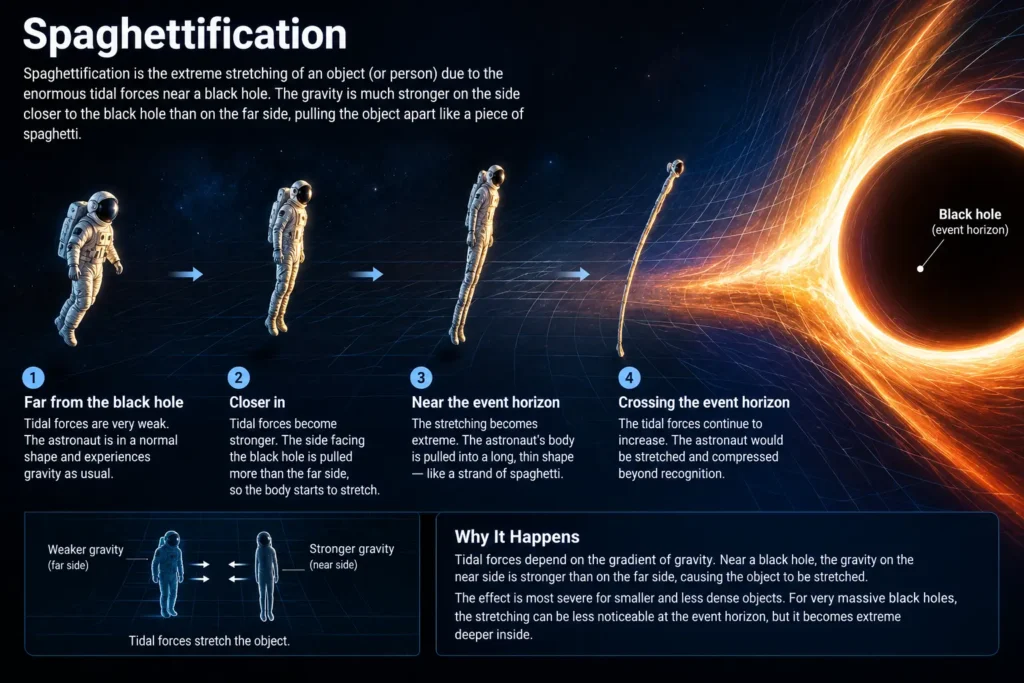
The danger depends on the black hole’s mass. Near a smaller black hole, tidal forces can become fatal before you reach the event horizon. However, a sufficiently massive black hole has a much larger event horizon, where tidal forces can be relatively weak. You might therefore cross the boundary without being immediately destroyed.
That does not mean you would survive indefinitely. As you travelled deeper inside, tidal forces could grow strong enough to destroy you. Your fate would depend on the black hole’s properties and your trajectory. A supermassive black hole might delay spaghettification, but it would not eliminate the danger of falling inside.
4. Is Gargantua in Interstellar Scientifically Accurate?
Gargantua, the enormous black hole featured in Christopher Nolan’s 2014 science-fiction film Interstellar, is one of cinema’s most famous attempts to portray a black hole using real physics. Its glowing accretion disk appears to wrap around the dark center, creating an image that looks almost impossible. Yet the effect is based on a genuine phenomenon: gravitational lensing, in which a black hole’s gravity bends light traveling around it. This bending allows parts of the disk behind the black hole to appear above and below its shadow, producing the striking visual distortion seen in the film.
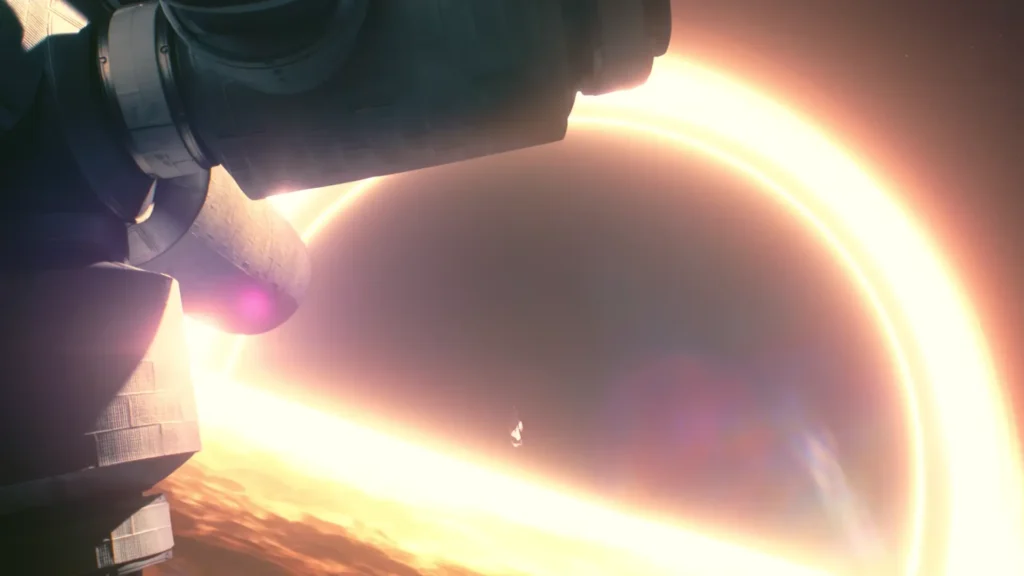
The film’s scientific foundation came from physicist Kip Thorne and the visual-effects team, who developed specialized software to calculate how light travels around a rapidly rotating black hole. Their work was detailed in a scientific paper published in 2015.
However, the film did make artistic compromises. The Event Horizon Telescope collaboration explains that the filmmakers reduced the visual effects of the Doppler shift to make the accretion disk look more symmetrical and understandable. In reality, the approaching side would generally appear brighter and bluer, while the receding side would appear dimmer and redder.
The verdict: Gargantua is scientifically informed, not a verified prediction of every detail. Its appearance demonstrates real physics, while other events in Interstellar extend into speculation and science fiction.Research note: Consult Kip Thorne’s The Science of Interstellar and the Event Horizon Telescope’s assessment of movie black holes.
4.1 Why Does Gargantua Look Different From a Simple Black Circle?
In Interstellar, Gargantua looks very different from the simple black circle often shown in illustrations. This appearance is caused by gravitational lensing. A black hole’s powerful gravity bends the paths of light traveling near it, allowing light from different parts of the surrounding accretion disk to reach the observer from unusual directions. As a result, parts of the disk appear above and below the black hole’s dark shadow, creating a bright, curved structure around it.
The film’s visual effects team used scientific calculations to make Gargantua look physically plausible. However, the final cinematic image was also designed for visual clarity and storytelling. It should not be treated as a direct photograph of a real black hole.
5. Could Cooper Survive Falling Into Gargantua?
In Interstellar, Cooper makes the decision to enter Gargantua so that Brand can continue her mission. What follows, however, combines established physics with speculative science fiction.
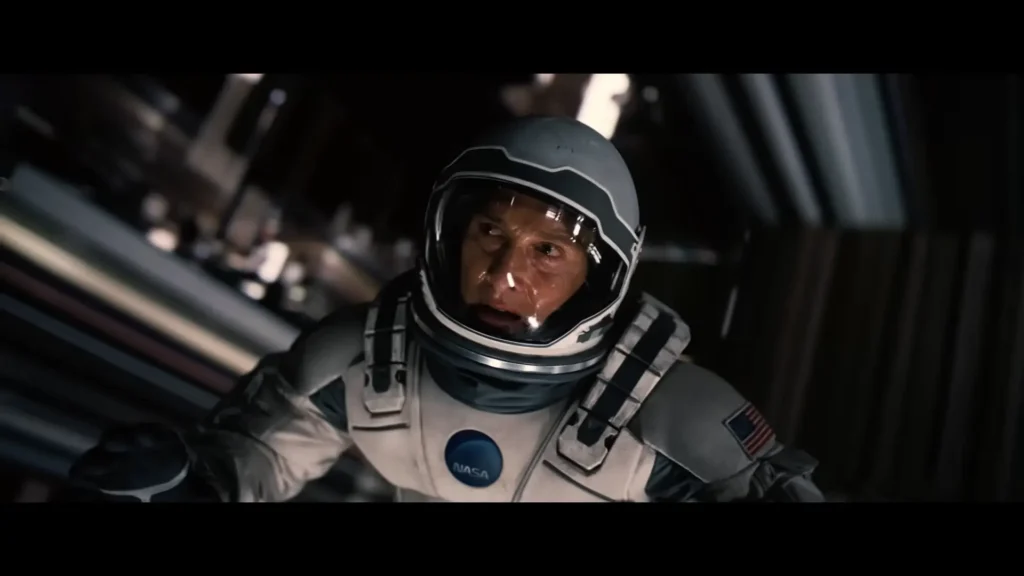
According to general relativity, a sufficiently massive black hole could theoretically allow a person to cross its event horizon without experiencing an immediate, dramatic physical effect. If the black hole is large enough and the surrounding environment is not dangerously hot or filled with intense radiation, tidal forces at the horizon might be relatively weak.
However, crossing the event horizon alive does not mean a person could survive indefinitely inside the black hole. As Cooper travels deeper, increasing tidal forces and the extreme conditions near the singularity would pose serious problems. Our current understanding of physics does not provide a confirmed way for someone to escape after crossing the event horizon.
The film’s tesseract sequence, where Cooper experiences time like 4th dimension and communicates with Murph across different moments, goes beyond established scientific knowledge. Although the sequence draws inspiration from ideas about higher dimensions and gravity, there is no evidence that a real black hole would create such a structure or allow this kind of communication.
The key takeaway: Cooper’s initial survival is theoretically conceivable under certain conditions, but that does not prove his entire experience inside Gargantua is physically possible but according to science Time dilation is possible.
6. What Would a Human Actually Experience Inside a Black Hole?
A human falling into a black hole would experience events differently from someone watching from far away. For the falling astronaut, their own clock would continue to tick normally as they approached and crossed the event horizon. A distant observer, however, would see the astronaut’s signals become increasingly delayed and redshifted, making the astronaut appear to fade from view rather than visibly cross the horizon.
This difference arises from gravity and the curvature of spacetime, as described by Einstein’s theory of general relativity. The astronaut’s physical experience would depend on the black hole’s mass, rotation, and surrounding environment.
Tidal forces would also play a crucial role. Gravity acting more strongly on one part of the astronaut’s body than another could stretch and compress them. Around a sufficiently massive black hole, these forces might be relatively weak at the event horizon but become destructive farther inside.
What happens next cannot be described with one universal sequence. The astronaut’s fate depends on the specific black-hole model, and our understanding becomes incomplete near the predicted singularity, where current theories cannot fully describe the physics.
7. Can Anything Escape After Crossing a Black Hole’s Event Horizon?
According to classical general relativity, nothing that crosses a black hole’s event horizon can escape back to the outside universe—not even light. The event horizon is not a solid surface; it marks a boundary beyond which all future-directed paths lead deeper inward rather than back outside.
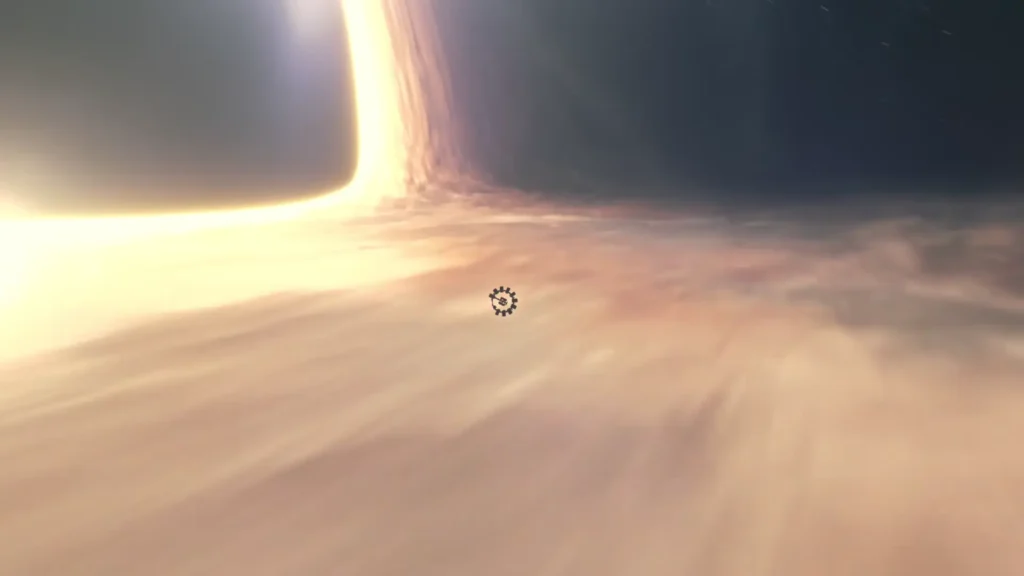
This is different from orbiting a black hole. Objects can orbit outside the event horizon under suitable conditions, but they cannot maintain an ordinary orbit from within it and then escape to safety.
The bright light often shown around a black hole usually comes from its accretion disk, a region of hot gas and dust orbiting outside the event horizon. That radiation can travel outward because it originates outside the boundary; it is not escaping from inside the black hole.
Hawking radiation is a separate theoretical phenomenon arising from quantum effects near a black hole’s horizon. It is not ordinary light escaping from the interior. Although it suggests black holes can gradually lose energy, it does not provide a known method for an astronaut or object to escape after crossing the event horizon.Key takeaway: Once inside a classical event horizon, a person cannot simply turn around and fly back out.
8. What Does a Real Black Hole Picture Look Like?
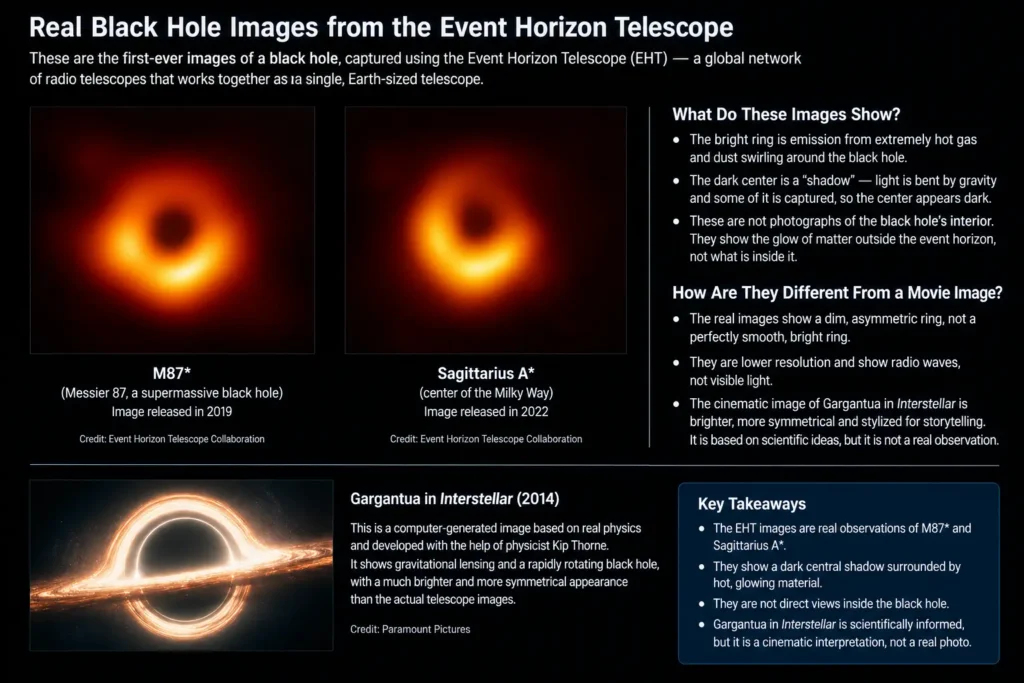
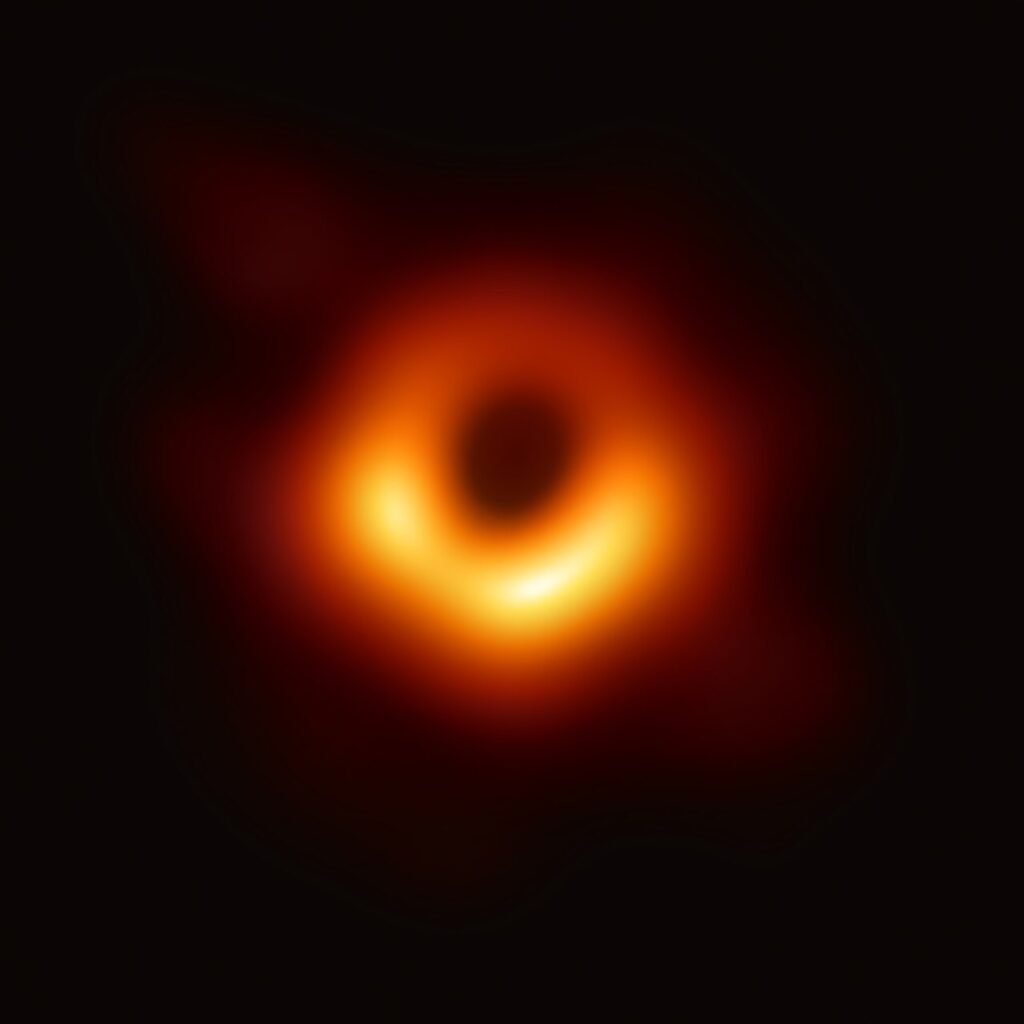
Real black hole images look different from the dramatic visuals seen in science-fiction movies. In 2019, the Event Horizon Telescope (EHT) collaboration released the first image of the supermassive black hole M87*. In 2022, it revealed an image of Sagittarius A*, the black hole at the center of our Milky Way galaxy.
Both images show a dark central region surrounded by a glowing, ring-like structure. The glow comes from radio emissions produced by extremely hot material around the black hole, while the dark center represents its shadow, shaped by the way gravity bends light.
These images are not ordinary photographs of a black hole’s interior. Instead, they are reconstructions made from radio-telescope observations of the region surrounding the black hole.
Compared with these real observations, Gargantua in Interstellar appears brighter and more visually dramatic. Its design draws on scientific calculations, but it is a computer-generated cinematic interpretation rather than an actual astronomical photograph.
Image suggestion: Use the official Event Horizon Telescope images of M87* and Sagittarius A* to help readers compare real scientific observations with Gargantua’s movie appearance. Telescope image with appropriate credit.
9. Interstellar vs Reality: What Does Science Actually Support?
Scientific comperision between reality and fiction:
| Topic | What science supports | What the movie adds |
|---|---|---|
| Gravitational lensing | Light can be bent by curved spacetime | A carefully designed cinematic image |
| Event horizon | A boundary beyond which escape is impossible in classical general relativity | Cooper’s dramatic journey through Gargantua |
| Tidal forces | Their severity depends on the black hole and the observer’s location | The film’s particular survival scenario |
| Time dilation | Gravitational and relative-motion effects can change elapsed time | The specific conditions and narrative consequences shown in the film |
| Tesseract | No confirmed equivalent is established by current evidence | A fictional higher-dimensional setting |
| Black-hole interior | Classical theory makes predictions but has important limitations | A visually and narratively constructed sequence |
Image Credit: Screenshots from Interstellar (2014), directed by Christopher Nolan. All rights belong to their respective copyright holders. Images are used for commentary, criticism, and educational discussion.