

Introduction
What if you could see your entire life’s event live in front of your eyes everything still happening, from your childhood to your persent, every person, every happiness and misery you went through.
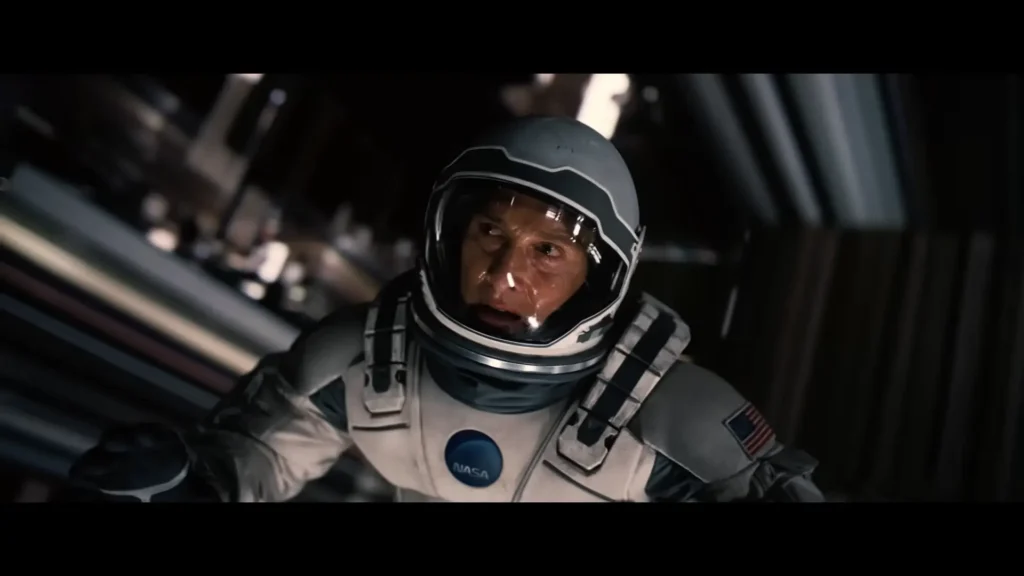
This sounds impossible? but it is one of the most fascinating idea was shown in Christopher Nolan’s Interstellar.
Near the end of the movie, Cooper The main charecter finds himself inside a mysterious structure called the tesseract. From there, he can see countless moments from his daughter Murphy’s bedroom. From the behind of bookself He can see everything even he can throw the books, it becomes a window into different moments in time. Movie has shown it like 4th dimension in which he enteres when he jumped into a black hole.
But what exactly is a 4th dimension?
Is the fourth dimension simply time? as physicists often describe it? Or could there actually be another spatial direction beyond the three dimensions we experience every day? And if a fourth dimension exists, could something living in higher dimensions see our entire three-dimensional world in a way that we cannot?
Interstellar uses these ideas to create one of the most mind-bending scenes in modern science fiction. But beneath the movie’s fictional story are real concepts from relativity, geometry, and theoretical physics.
In this article, I’ll break down the fourth dimension in simple terms and separate what science tells and what Interstellar Movie Based on. Welcome to MMB.
What Exactly Is a Dimension?
Before understanding the fourth dimension, we first need to understand what a dimension actually means.
In simple term, a dimension is a direction in which something can have a position or move.
Think about a tiny dot on a piece of paper. That dot has no length, width, or height. Mathematically, it can be considered zero-dimensional. Now imagine moving that dot in one direction. It creates a line. That’s one dimension.
Add another direction, sideways and you can create a square.
That’s two dimensions.
Add a third direction ,up and down and you get a cube.
That’s three dimensions.
We experience these three spatial dimensions every day:
- Length — left and right
- Width — forward and backward
- Height — up and down
Everything you see around you, from your phone to a mountain to a spaceship, exists within these three dimensions of space.
But physics introduces something even stranger.
Time.
And this is where the idea of the fourth dimension begins according to many scientists.
The important question
If our universe has three dimensions of space, does that automatically make time the fourth dimension?
The answer is yes—but with an important qualification.
In Einstein’s theory of relativity, space and time are not treated as completely separate things. They are combined into a single four-dimensional framework called spacetime.
And that is exactly where Interstellar becomes much more interesting.
Is Time Really the 4th Dimension?
When we hear the word dimension, we usually imagine a direction in space. We can move forward and backward, left and right, and up and down. But time behaves differently.
We cannot turn around and walk into yesterday. We cannot take a shortcut through tomorrow. Yet according to Einstein’s theory of relativity, time is deeply connected to the three dimensions of space.
Together, they form what physicists call spacetime.
Let us imagine that every event in the universe needs four coordinates to identify exactly when and where it happens:
- X — position in one spatial direction
- Y — position in another spatial direction
- Z — position in the third spatial direction
- T — time
But Is Time the Same as the Other Dimensions?
Not exactly.
This is where the phrase often use by many Genious “time is the fourth dimension” can become misleading. We can move in this 3d world anywhere, If you are standing in your room, you can walk forward, backward, left, right, or climb upward. But you don’t have the same freedom with time.
We can experience time in one direction—from the past toward the future.
More importantly, the mathematical structure of spacetime treats time differently from the spatial dimensions. Time is therefore a dimension, but it isn’t simply another spatial direction that you could turn toward and walk through.
This distinction becomes extremely important when we look at Interstellar.
How Interstellar Uses the Idea of Time as a Dimension
In Interstellar, time is not one directional entity flowing with constant speed. It becomes a property that can be affected by gravity and motion. When Cooper and his Team visits the Miller’s planet orbiting close to the enormous black hole Gargantua, they experience something extraordinary: time passes much more slowly for them than for people farther away from the black hole. There 1 hour time was equal to 7 years of Earth’s time.
This is a real consequence of Einstein’s theory of general relativity.
The movie famously represents it through the statement that one hour on the planet corresponds to several years for people far away. This phenomenon is known as gravitational time dilation.
Want to understand exactly how time dilation works in Interstellar?
We have already explained the science behind Gargantua, the water planet, and why minutes for Cooper can mean years for people back on Earth.
But there’s still a much bigger question.
could there also be a fourth spatial dimension? And what would such a dimension actually look like? That takes us from Einstein’s spacetime into the strange world of higher-dimensional geometry.
Is There a Fourth Spatial Dimension?
When physicists say that time is the fourth dimension, they are talking about four-dimensional spacetime. But mathematicians can also describe something completely different: a fourth spatial dimension.
Instead of adding time to our three dimensions of space, imagine adding another direction that is perpendicular to all three. The problem is that we cannot visualize this direction directly.
Our brains are adapted to a three-dimensional world. We can easily understand a line, a square, or a cube because we can see or physically interact with them. But a genuine four-dimensional spatial object is impossible to observe directly in the same way.
Still, mathematics gives us a way to understand the idea.
From a Point to a Tesseract
Think about how geometric objects increase in dimensions:
Point → Line → Square → Cube → Tesseract
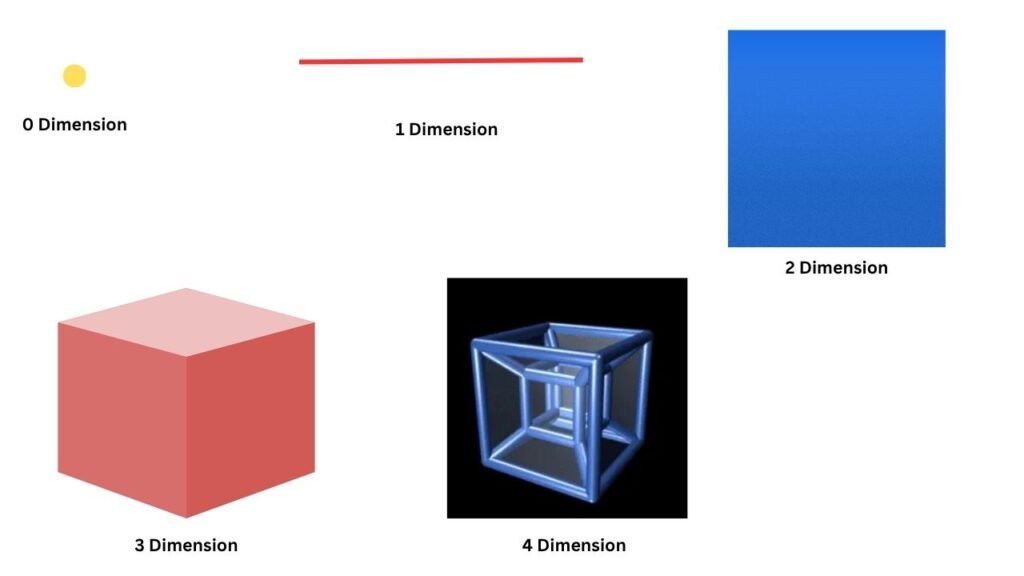
Now imagine moving entire cube in a fourth spatial direction. The result would be a four-dimensional object called a tesseract, also known as a 4D hypercube.
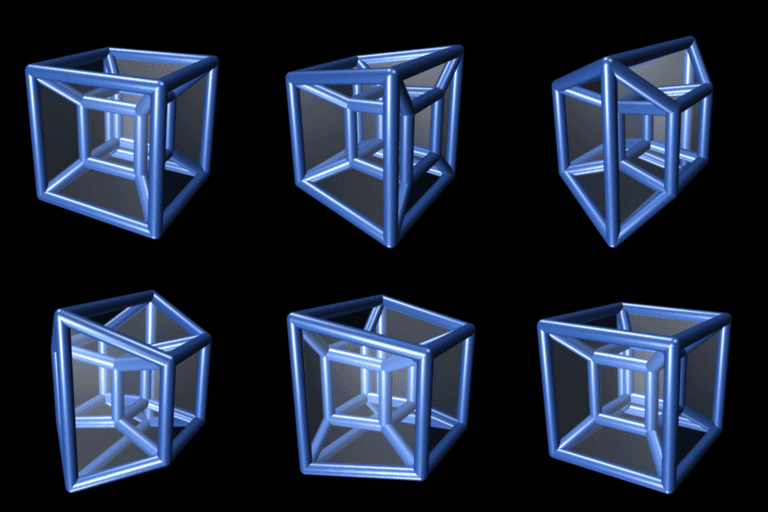
We cannot see the complete tesseract directly. Instead, we can create projections of four-dimensional objects into our three-dimensional world. That’s why illustrations of tesseracts often look like a smaller cube inside a larger cube, connected by lines.
The picture isn’t the actual four-dimensional object. It is more like a shadow or projection of something that exists mathematically in four spatial dimensions.
Could a 4D Being See Inside Our World?
Imagine a creature that lives on a perfectly flat sheet of paper like bacteria. For this creature, the universe has only two dimensions, length and width. It can move left, right, forward, and backward, but it has no concept of up or down.
Now place a three-dimensional object, such as a sphere, above its world. If the sphere passes through the paper, the 2D creature wouldn’t see the entire sphere. It would see something strange. First, a tiny circle would appear. Then the circle would become larger, then smaller. Finally, it would disappear.
From the creature’s perspective, an object mysteriously appeared, changed size, and vanished. But we know what actually happened. The sphere simply moved through a third spatial dimension that the creature couldn’t understand.
Now turn the idea around
We live in three spatial dimensions.
So imagine that a hypothetical being could move through a fourth spatial dimension that we can not understand. To such a being, our three-dimensional world could potentially appear as limited as the 2D world appears to us.
In a purely mathematical thought experiment, a 4D observer could have access to aspects of a three-dimensional object that are inaccessible to us from within our three-dimensional space.
For example, imagine a sealed box.
For us we normally have to open the box to see what’s inside.
But a hypothetical 4D observer could, in principle, approach our 3D world from a direction that doesn’t exist within our three-dimensional space. It could potentially interact with the interior without opening the box in the ordinary sense.
This is one reason higher-dimensional beings appear so often in science fiction. They could seem to perform actions that look physically impossible to us simply because they have access to a direction that we don’t.
But could such beings actually exist?
We don’t know.
Mathematics can describe four-dimensional spaces perfectly well, but that doesn’t mean that a four-dimensional spatial world or beings living in it actually exists in nature. Some modern theories of physics propose additional spatial dimensions, but no extra spatial dimension has been experimentally confirmed.
So when we talk about a 4D being seeing inside our world, we’re entering the territory of mathematical possibilities and theoretical physics, not established fact. And this brings us directly to one of the most fascinating questions raised by Interstellar:
What Is the Tesseract in Interstellar?
After Cooper falls toward Gargantua the massive black hole, he expects that he would die. But, he finds himself somewhere completely unexpected, a strange structure filled with countless versions of Murphy’s bedroom.
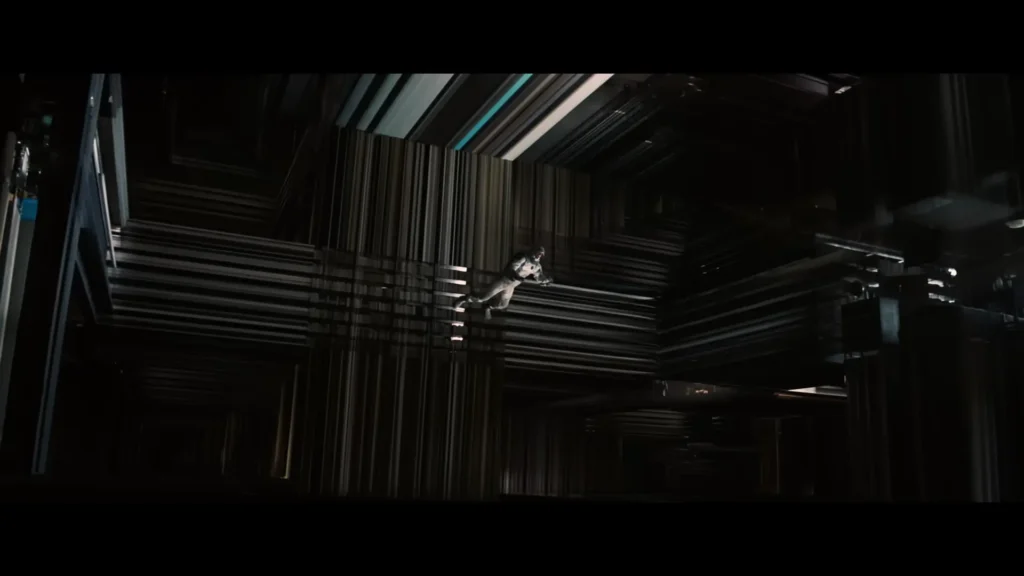
This is the tesseract.
At first, it looks like Cooper has somehow been transported to a bizarre room. But the reality is much stranger. The tesseract allows Cooper to perceive different moments in time simultaneously.
He can see Murphy’s bedroom when she is a child, when she is older, and at other points in her life. From Cooper’s perspective, time no longer behaves like a simple sequence of events that can flows in direction.
It appears almost like a physical landscape.
This is one of the most important ideas in Interstellar: if a sufficiently advanced being could perceive time as another dimension, then events that are separated by years for us might potentially be viewed together.
Cooper Can See Time Instead of Simply Experiencing It
Normally, we experience life moment by moment.
You are reading this sentence now. A few seconds ago you read the introduction, belongs to your past, while the next sentence you are going to read belongs to your future.
You can’t step outside this flow and look at all those moments simultaneously. But inside the tesseract, Cooper appears to gain a different perspective. He can move through different locations in Murphy’s bedroom, but each location corresponds to a different moment in time.
The movie is essentially asking:
What would our universe look like if time could be viewed the way we normally view space?
That is not something established physics says humans can actually do. It is a science-fiction visualization of higher-dimensional spacetime. And there is another fascinating detail. Cooper doesn’t simply observe Murphy’s past. He realizes that he can interact with it.
How Does Cooper Communicate Through Time?
Cooper discovers that gravity can somehow influence objects in Murphy’s bedroom.
He tries to communicate with Murphy by moving books from the bookshelf. Later, he realizes that he can use the movement of the second hand of her watch to transmit information in morse code. Eventually, Cooper sends Murphy the crucial quantum data needed to solve the gravitational equation. This creates one of the movie’s biggest scientific mystery:
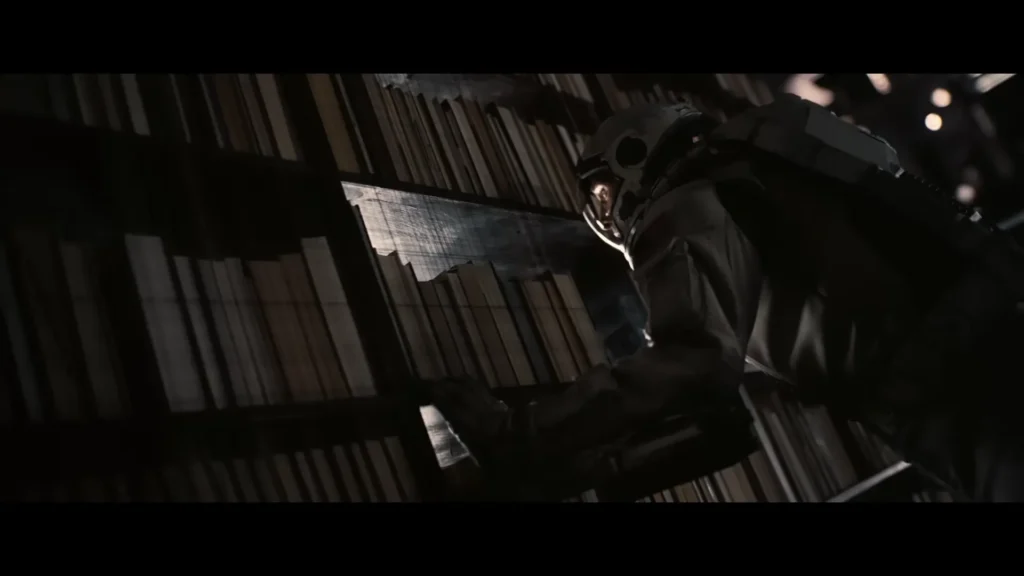
How can Cooper send information from his location in the tesseract to an earlier point in Earth’s history?
The movie’s answer involves gravity.
The higher-dimensional beings have apparently constructed the tesseract in such a way that Cooper can use gravitational effects to interact with different moments of Murphy’s life.
But this is where we need to separate real physics from movie physics.
What is based on real science?
Gravity really does affect time.
According to general relativity, clocks in stronger gravitational fields run differently from clocks in weaker gravitational fields like Time in geosynchronus satellite which is have lower gravitational field than earth passes faster , because they are 22,236 miles away from earth. This is the same basic phenomenon behind the time dilation experienced near Gargantua.
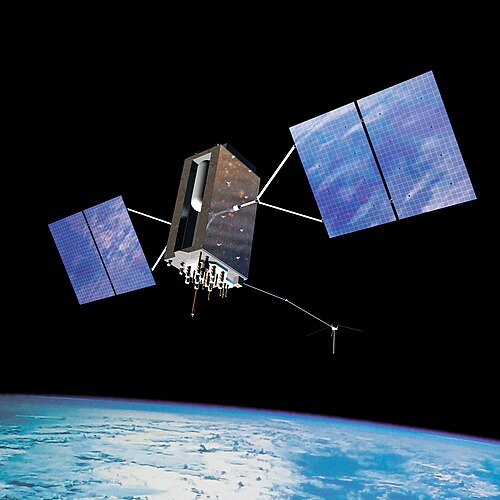
Gravity is also intimately connected to the geometry of spacetime.
What is fictional?
There is currently no Known technology or known physical mechanism that allows a person to use gravity to send a message into their own past. So Cooper’s communication with Murphy is science-inspired fiction.
And that’s what makes Interstellar so interesting.
The movie takes a genuine idea from physics spacetime is affected by gravity and pushes it into an extreme hypothetical scenario.
Does Interstellar Get the Dimensions Right?
Partly—but the movie is taking considerable creative freedom.
The basic scientific ideas are real:
- Our universe can be described using three spatial dimensions plus time.
- General relativity treats space and time as interconnected.
- Gravity affects the passage of time.
- Higher-dimensional spaces can be described mathematically.
- A tesseract is a legitimate mathematical object a four-dimensional hypercube.
But the movie takes these concepts much further.
There is currently no experimental evidence that humans can enter a higher spatial dimension, view their entire timeline, or communicate with the past using gravity.
Could Humans Ever Experience a Higher Dimension?
This is one of the biggest unanswered questions.
We can mathematically describe four-dimensional spaces, and physicists can build theories involving additional dimensions. But our direct experience remains limited to three dimensions of space. We can create computer simulations, drawings, and physical models that represent higher-dimensional objects, but these are only projections or representations.
A tesseract illustration, for example, isn’t a four-dimensional object sitting on your screen. It is a three-dimensional representation of something that mathematically exists in four dimensions.
This is similar to how a photograph of a cube is not actually a cube. It is a lower-dimensional representation of one. So while mathematics allows us to explore higher dimensions, that doesn’t prove that we can physically enter them or that extra spatial dimensions exist in the form science fiction imagines.
And that brings us to another fascinating possibility:
Could extra dimensions actually exist somewhere in our universe without us being able to see them?
Could Extra Dimensions Really Exist?
The idea of an extra spatial dimension sounds like science fiction, but it isn’t completely outside serious physics.
Some theories attempt to describe the universe using more than four dimensions. One famous example is string theory, in which additional dimensions are required by the mathematics of the theory.
But there’s an important catch:
A mathematical possibility is not the same thing as an experimentally confirmed reality. Scientists have not yet found direct evidence that our universe contains an additional large spatial dimension that humans could move through.
Why Haven’t We Seen Them?
If an extra spatial dimension exists, one possibility is that it could be extremely small or compactified.
Imagine an ant walking along a garden hose.
From far away, the hose looks like a one-dimensional line. The ant, however, can also move around the circular surface of the hose. That circular direction is real, but from a large distance it is difficult to notice. Some theoretical models use a somewhat similar idea for additional dimensions: they could exist at scales far too small for us to experience directly.
Scientists have also searched for experimental clues that could point toward extra dimensions, including unusual behavior in particle physics and possible deviations from the expected behavior of gravity. So far, however, no confirmed observation has established that an extra spatial dimension exists.
What Would Happen If We Could Enter a Fourth Spatial Dimension?
This is where our imagination starts to break down.
We are comfortable moving through three dimensions because that’s how our physical world works. But a fourth spatial direction would be fundamentally different from simply moving higher or lower.
It wouldn’t be:
up + another direction.
It would be a completely new direction that is mathematically independent of length, width, and height. And we will feel like 2 creature was feeling in begning of this article , it would be miracle to us.
Could the 4th Dimension Allow Time Travel?
This is perhaps the most exciting question surrounding the fourth dimension.
If time is considered a dimension, does that mean we should be able to move through it just like we move through space?

Unfortunately, things aren’t that simple.
We already travel through time every second. The real question is whether we could control how quickly we move through it or even travel backward.
Traveling Into the Future Is Actually Possible
According to Einstein’s theory of relativity, time doesn’t pass at exactly the same rate for everyone. If you travel at extremely high speeds, close to the speed of light, time passes more slowly for you relative to someone who remains behind. This is called time dilation. I an not going in depth because this article will be too long but I have already covered this topic in depth you can read our gravitational time dilation blog.
So, in a sense, forward time travel is real physics.
What About Traveling Backward in Time?
This is where science becomes much more uncertain.
General relativity contains some mathematical solutions that appear to permit unusual structures involving time, including closed timelike curves. Wormholes are also sometimes discussed as a possible mechanism for time travel. Here is much more complication as we know famous The Grandfather paradox.
Does Interstellar Show Real Time Travel?
Not exactly.
Cooper doesn’t simply jump from the year 2067 to an earlier year in a conventional time machine.
Instead, the movie presents a much more unusual scenario.
Inside the tesseract, Cooper appears to gain access to different moments of Murphy’s timeline. He then uses gravitational effects to transmit information to her. The movie’s explanation relies on the idea that beings with access to higher dimensions could interact with spacetime in ways that are impossible for ordinary humans.
That’s a fascinating science-fiction interpretation, but it isn’t a technique that modern physics has shown us how to perform.
And this is an important distinction for Movie Myth Breaker:
The movie’s underlying physics is inspired by real science, but the ability to manipulate time the way Cooper does is fictional.
So, Is the 4th Dimension Real?
Yes, but the answer depends on what we mean by “fourth dimension.”
In modern physics, our universe is commonly described using four dimensions of spacetime: three dimensions of space and one of time.
That doesn’t mean scientists have discovered a mysterious fourth spatial direction that humans can enter.
A fourth spatial dimension is a perfectly valid mathematical concept, and some theoretical physics models propose additional dimensions. But there is currently no confirmed experimental evidence that humans can access such a dimension.
Frequently Asked Questions About the 4th Dimension
Is the 4th dimension time?
In physics, time is commonly treated as the fourth dimension of spacetime, alongside 3 dimensions of space. However, time behaves differently from the spatial dimensions, so it shouldn’t be thought of as simply another direction that we can move through freely.
What would the 4th dimension look like?
If you’re talking about a fourth spatial dimension, we cannot directly visualize it because our everyday experience is limited to three spatial dimensions. Mathematics can represent four-dimensional objects such as a tesseract, which can be projected into three-dimensional images.
What is a 4D tesseract?
A tesseract is the four-dimensional equivalent of a cube. Just as a cube has six square faces, a tesseract consists of three-dimensional cells arranged in four-dimensional space. It is also called a 4D hypercube.
Could a 4th dimensional being exist?
There is currently no experimental evidence for four-dimensional spatial beings. Such beings are possible as mathematical concepts and appear frequently in science fiction, but science has not established that they exist in our universe.
Could a 4D being see inside us?
In a mathematical thought experiment, a hypothetical four-dimensional observer could interact with our three-dimensional world in ways that would seem impossible to us. This is similar to how we could look at the inside of a two-dimensional shape from outside its plane.
However, this is a geometric analogy, not evidence that real 4D beings can see inside humans.
Does the 4th dimension allow time travel?
The fact that time is treated as a dimension does not mean humans can freely travel through it. Relativity does allow time dilation, meaning people traveling at very high speeds or experiencing different gravitational conditions can age at different rates. Backward time travel, however, remains speculative.
Did Interstellar scientifically prove the 4th dimension?
No. Interstellar uses real concepts such as spacetime, relativity, gravity, and higher-dimensional mathematics, but its tesseract and ability to interact with different moments in time are fictional or speculative elements.
Image Credits: Screenshots from Interstellar (2014), directed by Christopher Nolan. © Warner Bros. Pictures and Paramount Pictures. Images are used for commentary, criticism, education, and analysis.
Read More Articles:
Gravitational Time Dilation Explained: Is Interstellar Accurate?
Is Time Travel Possible? Science Behind Avengers Endgame
Inception dream: The Shocking Science Behind dreams.