
Introduction
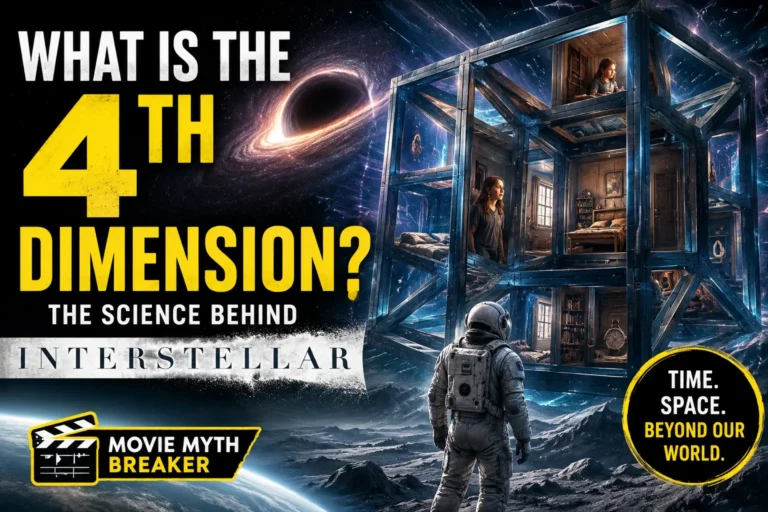
“Every hour we spend on that planet will be seven years back on Earth.”
This famous line from Christopher Nolan’s Interstellar left millions of viewers wondering the same question:
Can gravity really slow down time?
It sounds like science fiction, but surprisingly, the answer is yes.
The movie is based on a real scientific phenomenon called gravitational time dilation, one of the most remarkable predictions of Albert Einstein’s General Theory of Relativity. According to Einstein, time is not constant across the universe. Instead, it changes depending on gravity and motion.
This is why astronauts on Miller’s Planet, which orbits the supermassive black hole Gargantua, experience only a few hours while decades pass for people waiting elsewhere.
But is this scientifically possible?
Could one hour really equal seven years?
How do black holes and time dilation work together?
And how accurate is Interstellar compared with real physics?
In this article, we’ll answer all these questions in simple language. You’ll learn the science behind gravitational time dilation, understand the equation for time dilation, explore how Interstellar time dilation works, and discover whether the movie stays true to Einstein’s theories.
What Is Gravitational Time Dilation?
Gravitational time dilation is the phenomenon where time passes more slowly in stronger gravitational fields than in weaker ones.
In simple words:
The stronger the gravity, the slower time flows.
This isn’t just a theoretical idea—it has been experimentally verified and even affects technologies we use every day, such as GPS navigation.
Why Does Time Slow Down?
According to Einstein, gravity isn’t an invisible force pulling objects together. Instead, massive objects like planets, stars, and black holes curve spacetime.
Since time is part of spacetime, bending spacetime also changes the rate at which time passes.
Imagine two identical clocks:
- One is placed on Earth’s surface.
- The other is placed aboard a GPS satellite orbiting Earth.
After a while, the satellite’s clock will show slightly more time has passed because it experiences weaker gravity.
Although the difference is only a few microseconds per day, scientists measure and correct for it constantly. Without those corrections, GPS systems would quickly become inaccurate.
This is direct evidence that gravitational time dilation is real.
Key Characteristics of Gravitational Time Dilation
Here are the most important facts:
- Predicted by Albert Einstein in 1915.
- Based on General Relativity.
- Stronger gravity slows the passage of time.
- Weaker gravity allows time to pass faster.
- Confirmed using atomic clocks and satellite experiments.
- Essential for GPS accuracy.
- Becomes extreme near neutron stars and black holes.
Everyday Examples of Gravitational Time Dilation
Although we don’t notice it in daily life, gravitational time dilation happens everywhere.
Examples include:
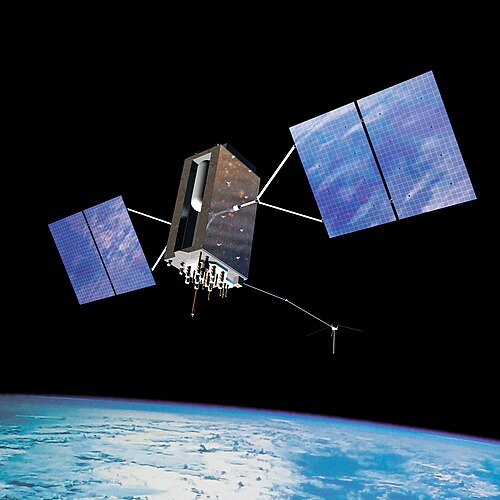
- GPS Satellites
- Orbit in weaker gravity than Earth’s surface.
- Their clocks run about 45 microseconds faster each day due to gravity.
- Mountains vs Sea Level
- A clock on a mountain runs slightly faster than one at sea level because gravity is weaker at higher altitude.
- Black Holes
- Near a black hole, gravity is so intense that time can slow dramatically compared with distant observers.
These examples show that gravitational time dilation isn’t science fiction—it’s a measurable part of our universe.
Einstein’s Theory Explained Simply
To understand gravitational time dilation, we first need to understand Einstein’s biggest idea.
Before Einstein, scientists believed gravity was simply a force that attracted objects to one another. This explanation, developed by Isaac Newton, accurately described the motion of planets and falling objects.
Einstein introduced a completely different perspective.
He proposed that space and time are woven together into a four-dimensional fabric called spacetime.
Whenever an object has mass, it bends this fabric.
The more massive the object:
- The deeper the curve in spacetime.
- The stronger its gravitational field.
- The slower time passes nearby.
Instead of thinking about gravity as an invisible pulling force, imagine placing a heavy bowling ball on a stretched rubber sheet.
The ball creates a deep depression.
Now place a marble nearby.
The marble rolls toward the bowling ball—not because it’s being pulled by an invisible force, but because the surface beneath it is curved.
Einstein suggested that the universe works in a similar way.
Planets orbit the Sun because the Sun bends spacetime.
Stars orbit the center of galaxies because spacetime is curved there.
Even light bends when it passes near massive objects because it follows the curved geometry of spacetime.
And because time is part of that geometry, gravity changes how quickly time flows.
Why Gravity Slows Time
Imagine two astronauts with identical atomic clocks.
Astronaut A
- Standing on Earth’s surface.
- Experiences stronger gravity.
Astronaut B
- Floating far away in deep space.
- Experiences much weaker gravity.
After several years, Astronaut B’s clock will show slightly more elapsed time.
This doesn’t mean the clocks are broken.
It means time itself flowed at different rates in the two locations.
That’s the essence of gravitational time dilation.
Difference Between Velocity Time Dilation and Gravitational Time Dilation
Many people assume there’s only one type of time dilation, but Einstein actually described two different ways that time can slow down.
Although they produce similar effects, they’re caused by completely different phenomena.
1. Velocity Time Dilation
Velocity time dilation comes from Special Relativity (1905).
The rule is simple:
The faster you travel, the slower time passes for you compared with someone at rest.
As an object approaches the speed of light, this effect becomes increasingly noticeable.
Real-world examples
- Muons created in Earth’s atmosphere survive longer than expected.
- Astronauts aboard the International Space Station age very slightly slower because they’re moving at about 28,000 km/h.
- Particle accelerators observe this effect routinely.

This type of time dilation depends on speed, not gravity.
2. Gravitational Time Dilation
Gravitational time dilation comes from General Relativity (1915).
Instead of speed, it’s caused by gravity.
The stronger the gravitational field:
- The slower time flows.
- The slower clocks tick.
- The slower aging occurs.
Examples include:
- GPS satellites
- Earth’s surface
- Neutron stars
- Black holes
- Miller’s Planet in Interstellar
Velocity Time Dilation vs. Gravitational Time Dilation
| Feature | Velocity Time Dilation | Gravitational Time Dilation |
|---|---|---|
| Theory | Special Relativity | General Relativity |
| Published | 1905 | 1915 |
| Cause | High speed | Strong gravity |
| Depends on | Velocity | Mass and gravity |
| Example | ISS astronauts | GPS satellites |
| Extreme case | Near light speed | Near black holes |
Although both effects exist simultaneously, Interstellar relies primarily on gravitational time dilation rather than velocity time dilation. Gargantua’s immense gravity—not the spacecraft’s speed—is what causes the extraordinary difference in time between Miller’s Planet and the rest of the universe.
How Interstellar Uses Gravitational Time Dilation
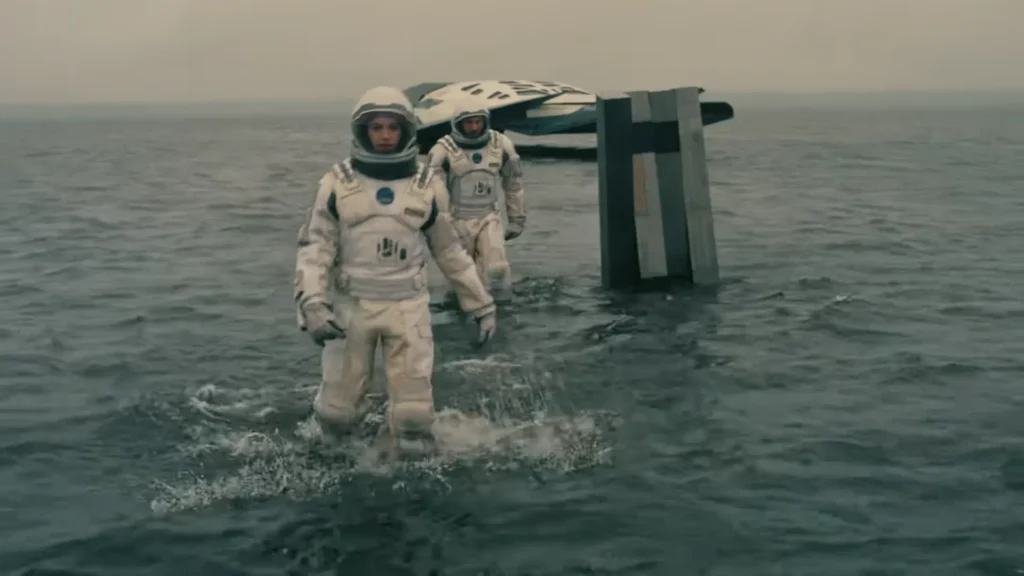
One of the reasons Interstellar is considered one of the most scientifically accurate science-fiction films is that it doesn’t invent fictional physics. Instead, it takes a real scientific phenomenon—gravitational time dilation—and pushes it to its theoretical limits.
The most famous example occurs on Miller’s Planet, the first potentially habitable world visited by Cooper’s team.
Before landing, Romilly warns the crew:
“Every hour we spend on that planet will be seven years back on Earth.”
This isn’t because the planet is moving incredibly fast.
It’s because Miller’s Planet orbits extremely close to Gargantua, a rapidly spinning supermassive black hole.
At that distance, gravity is so intense that time itself flows much more slowly than it does farther away.
What Happens in the Movie?
The sequence unfolds dramatically:
- Cooper’s team lands on Miller’s Planet.
- They spend only a few hours collecting data.
- Unexpected giant tidal waves delay their mission.
- When they return to the Endurance spacecraft, 23 years have passed for Romilly, who stayed in orbit.
- Back on Earth, Murph has grown from a child into an adult scientist.
Although emotionally devastating, this scene is rooted in genuine physics.
Why Doesn’t the Crew Notice Time Slowing Down?
This is one of the biggest misconceptions about gravitational time dilation.
Many people imagine that the astronauts would feel as though they were moving in slow motion.
That’s not how it works.
For Cooper and his team:
- Their watches tick normally.
- Their hearts beat normally.
- Conversations sound normal.
- Walking feels completely ordinary.
Nothing seems unusual.
However, an observer far away—such as Romilly aboard the Endurance—would measure their clocks running much more slowly.
This illustrates one of Einstein’s most surprising ideas:
Time is relative to the observer.
Both perspectives are correct because each observer exists in a different gravitational environment.
Black Holes and Time Dilation
To understand why Interstellar depicts such dramatic black holes and time dilation, we first need to understand what a black hole really is.
A black hole forms when an enormous amount of mass is compressed into an incredibly small region of space.
Its gravity becomes so strong that even light cannot escape once it crosses a boundary known as the event horizon.
The closer you move toward a black hole, the stronger gravity becomes.
As gravity increases:
- Space becomes more curved.
- Light bends more dramatically.
- Time flows increasingly slower.
This relationship between black holes and time dilation is one of the most remarkable predictions of General Relativity.
Why Are Black Holes So Extreme?
Earth has enough gravity to slow time by only tiny fractions of a second.
The Sun creates a stronger effect.
Neutron stars produce even greater time dilation.
But black holes are in a completely different league.
Here’s a comparison:
| Object | Effect on Time |
|---|---|
| Earth | Tiny (microseconds) |
| Sun | Slightly stronger |
| Neutron Star | Significant |
| Stellar Black Hole | Extreme |
| Supermassive Black Hole | Most extreme known |
Near the event horizon of a black hole, gravitational time dilation becomes so powerful that time appears almost frozen from the perspective of a distant observer.
This is why black holes are often associated with “time travel” in science fiction, although technically they don’t allow travel into the past.
Instead, they allow someone to experience less time than everyone else.
Why Gargantua Creates Extreme Time Dilation
Not every black hole could produce the conditions shown in Interstellar.
Gargantua is special for two important reasons.
1. Gargantua Is a Supermassive Black Hole
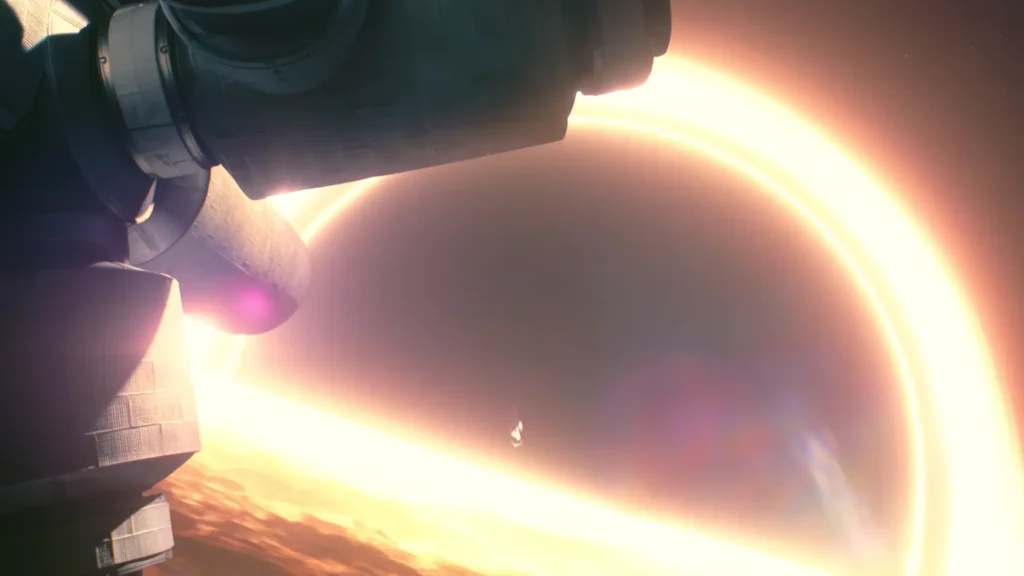
Unlike ordinary stellar black holes, Gargantua contains around 100 million times the mass of our Sun (according to physicist Kip Thorne’s calculations).
This enormous mass creates an incredibly deep gravitational well.
Interestingly, a supermassive black hole has one major advantage over a smaller black hole.
Although its gravity is much stronger overall, the tidal forces near its event horizon are comparatively gentler.
This means a spacecraft—or even a planet—could theoretically orbit much closer without being instantly torn apart.
That makes Gargantua a far better candidate for producing extreme gravitational time dilation.
2. Gargantua Spins Extremely Fast
Another crucial detail is that Gargantua is not an ordinary black hole.
It is a Kerr black hole, meaning it rotates at almost the maximum speed allowed by physics.
Why is this important?
A rapidly spinning black hole changes spacetime in several ways.
It creates a phenomenon called frame dragging, where the black hole literally drags spacetime around with it.
This has several consequences:
- Stable orbits can exist much closer to the event horizon.
- Objects can survive nearer to the black hole.
- Gravitational time dilation becomes even more extreme.
Without Gargantua’s rapid rotation, Miller’s Planet could not orbit close enough to experience the enormous time difference shown in the film.
Frame Dragging Explained
Imagine stirring honey with a spoon.
As the spoon rotates, it drags the honey around with it.
A spinning black hole behaves similarly.
Except instead of honey, it drags spacetime itself.
Scientists call this effect frame dragging or the Lense–Thirring effect.
This prediction of Einstein’s theory has been confirmed experimentally around Earth, although the effect is incredibly small compared to a rotating black hole.
Can One Hour Really Equal Seven Years?
This is the question almost everyone asks after watching Interstellar.
Let’s examine the numbers.
In the movie:
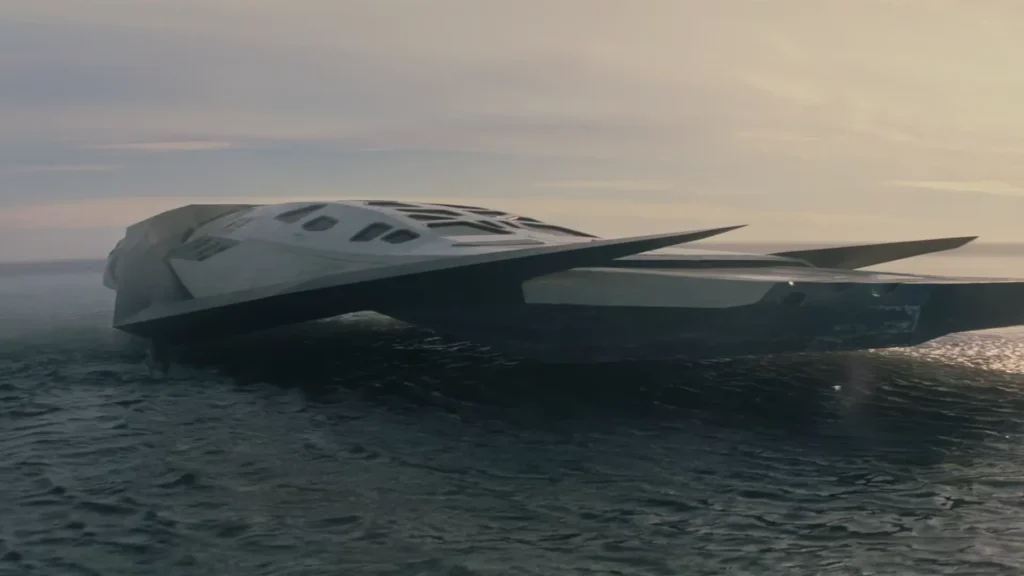
- 1 hour on Miller’s Planet
- equals
- 7 years on Earth
Converting everything into hours:
- 7 years ≈ 61,320 hours
This means time on Miller’s Planet flows approximately:
61,320 times slower than it does for observers farther away.
At first glance, this sounds impossible.
Surprisingly, Einstein’s equations don’t forbid it.
In theory, such an enormous time difference could occur if several extremely rare conditions were met.
These include:
- A supermassive black hole.
- An extremely rapid spin.
- A stable orbit located just outside the event horizon.
- Careful positioning to avoid destructive tidal forces.
These conditions are extraordinarily unlikely, but they don’t violate General Relativity.
That’s why physicist Kip Thorne, who advised Christopher Nolan during the production of Interstellar, concluded that the movie’s famous “one hour equals seven years” scenario is scientifically plausible, even though it represents one of the most extreme environments imaginable.
Of course, there are still unanswered questions. Miller’s Planet would likely be exposed to intense radiation from Gargantua’s accretion disk, and maintaining a habitable atmosphere under those conditions would be extremely challenging. The film takes some creative liberties here to serve the story.
Nevertheless, the central concept—that gravitational time dilation near a rapidly spinning supermassive black hole could produce an enormous difference in the passage of time—is firmly grounded in Einstein’s General Theory of Relativity.
How Accurate Is Interstellar? (Fact vs Fiction)
One of the biggest reasons Interstellar is praised by scientists is its commitment to real physics. While the movie includes fictional elements for storytelling, many of its core scientific ideas are surprisingly accurate.
Here’s a breakdown of what’s real and what belongs to science fiction.
| Movie Concept | Scientific Accuracy | Explanation |
|---|---|---|
| Gravitational Time Dilation | ✅ Highly Accurate | Based directly on Einstein’s General Theory of Relativity. |
| Gargantua’s Appearance | ✅ Highly Accurate | Designed using real equations provided by Kip Thorne. |
| Black Holes and Time Dilation | ✅ Accurate | Strong gravity really does slow the passage of time. |
| Frame Dragging | ✅ Accurate | A rotating black hole drags spacetime around it. |
| One Hour = Seven Years | 🟡 Theoretically Possible | Extremely unlikely but allowed by General Relativity under very specific conditions. |
| Miller’s Planet Remaining Habitable | 🟡 Speculative | Radiation from the accretion disk would probably make the planet hostile to life. |
| The Wormhole | 🟡 Theoretical | Predicted by equations but never observed. |
| The Tesseract Inside the Black Hole | ❌ Fiction | No scientific evidence supports this concept. |
| Communicating Through Gravity Across Time | ❌ Fiction | Created for the movie’s emotional ending rather than based on established physics. |
Overall Accuracy
Unlike many science-fiction films, Interstellar builds its story on real scientific principles. Most of the movie’s speculative elements appear only in the final act, while the physics of gravitational time dilation, black holes, and relativity remain remarkably faithful to modern science.
Real-Life Examples of Gravitational Time Dilation
Many people think gravitational time dilation exists only in movies.
In reality, scientists measure it regularly, and modern technology depends on it.
Here are some real-world examples.
1. GPS Satellites
Every smartphone uses GPS satellites to determine your location.
These satellites orbit approximately 20,200 km above Earth, where gravity is weaker than on the surface.
As a result:
- Their clocks run about 45 microseconds faster each day due to weaker gravity.
- Their speed causes a 7 microsecond slowdown because of velocity time dilation.
- The combined effect is a gain of about 38 microseconds per day.
Engineers correct these differences continuously.
Without accounting for gravitational time dilation, GPS navigation would drift by several kilometers each day.
2. Atomic Clock Experiments
Scientists have compared extremely precise atomic clocks placed at different heights.
Even moving a clock just a few centimeters higher changes how quickly it ticks.
These experiments confirm that:
- Higher altitude = weaker gravity = faster time.
- Lower altitude = stronger gravity = slower time.
Modern atomic clocks are so accurate that they can detect tiny changes in Earth’s gravitational field.
3. Muons and Relativity
Muons are unstable particles produced when cosmic rays strike Earth’s atmosphere.
Normally, they decay in only a few microseconds.
Yet scientists detect large numbers of them reaching Earth’s surface.
Why?
Because they travel close to the speed of light.
Their internal clocks run more slowly due to velocity time dilation, allowing them to survive much longer than expected.
Although this example involves speed rather than gravity, it provides another powerful confirmation that Einstein’s ideas about time are correct.
4. Gravity Probe and Satellite Experiments
Several space missions have tested Einstein’s predictions with extraordinary precision.
These include:
- Gravity Probe A
- Gravity Probe B
- Hafele–Keating experiment
- Modern optical atomic clock experiments
Each has confirmed that gravity changes the passage of time, exactly as General Relativity predicts.
What Scientists Think
Unlike many Hollywood movies, Interstellar received direct guidance from one of the world’s leading theoretical physicists.
Kip Thorne
Kip Thorne, a Nobel Prize-winning physicist and expert in black holes, served as the film’s scientific advisor.
His role wasn’t simply to review the script.
Christopher Nolan challenged him to ensure that every major scientific idea remained consistent with known physics whenever possible.
To create Gargantua, Thorne provided mathematical models describing how light should bend around a spinning black hole.
These calculations were so detailed that the visual effects team generated scientifically accurate images never seen before.
Interestingly, the simulations even contributed to scientific research by revealing new details about gravitational lensing.
What Modern Physics Says
Most physicists agree on several key points:
✅ Gravity changes the passage of time.
✅ Black holes create the strongest gravitational time dilation known.
✅ Supermassive spinning black holes could produce extraordinary time differences.
However, scientists also point out several uncertainties.
They remain skeptical about:
- A habitable planet surviving so close to an active black hole.
- The enormous tidal waves shown in the movie.
- Cooper surviving inside Gargantua.
- The existence of the tesseract.
In other words:
The movie begins with excellent science but gradually transitions into speculative science fiction.
Verdict
So, is Interstellar’s gravitational time dilation scientifically possible?
The answer is surprisingly close to yes.
Einstein’s General Theory of Relativity predicts that gravity changes the rate at which time passes.
Scientists have confirmed this using:
- GPS satellites
- Atomic clocks
- Space missions
- Particle physics experiments
The movie takes this real phenomenon to one of its most extreme theoretical limits.
Although one hour equaling seven years would require incredibly rare conditions around a rapidly spinning supermassive black hole, it doesn’t violate known physics.
Where Interstellar becomes fictional is in its depiction of the tesseract, communication through gravity across time, and Cooper’s survival inside the black hole.
Overall, Interstellar remains one of the most scientifically accurate science-fiction films ever made. It demonstrates that gravitational time dilation is not just a clever movie concept but a real feature of our universe that continues to fascinate physicists and science enthusiasts alike.
Frequently Asked Questions (FAQ)
1. What is gravitational time dilation?
Gravitational time dilation is the slowing of time in stronger gravitational fields. According to Einstein’s General Theory of Relativity, clocks closer to massive objects run more slowly than clocks farther away.
2. Is gravitational time dilation real?
Yes. Scientists have confirmed gravitational time dilation using atomic clocks, GPS satellites, and multiple space experiments. It is one of the best-tested predictions of General Relativity.
3. Why do black holes slow down time?
Black holes possess extremely strong gravitational fields that curve spacetime more than any other known objects. The stronger the gravity, the slower time passes for nearby observers.
4. Is one hour equal to seven years actually possible?
In theory, yes. Around an extremely massive, rapidly spinning black hole, Einstein’s equations allow for enormous time differences. However, such conditions would be extraordinarily rare.
5. What is the equation for gravitational time dilation?
A simplified gravitational time dilation formula is:t0=tf1−rc22GM
It relates the passage of time to an object’s mass and your distance from it.
6. Does GPS use gravitational time dilation?
Yes. GPS satellites experience weaker gravity than clocks on Earth, causing their clocks to run faster. Engineers constantly correct for this effect to keep navigation accurate.
7. Is Interstellar scientifically accurate?
Yes—mostly. The movie accurately portrays gravitational time dilation, black hole physics, frame dragging, and relativity. Some elements, such as the tesseract and communicating through gravity across time, are fictional additions for storytelling.
Read More Blogs:
Copyright Notice: Movie screenshots featured in this article are the property of their respective copyright holders. They are used only for educational analysis, commentary, criticism, and review under applicable fair dealing/fair use principles. Movie Myth Breaker does not claim ownership of these images.