
Introduction:
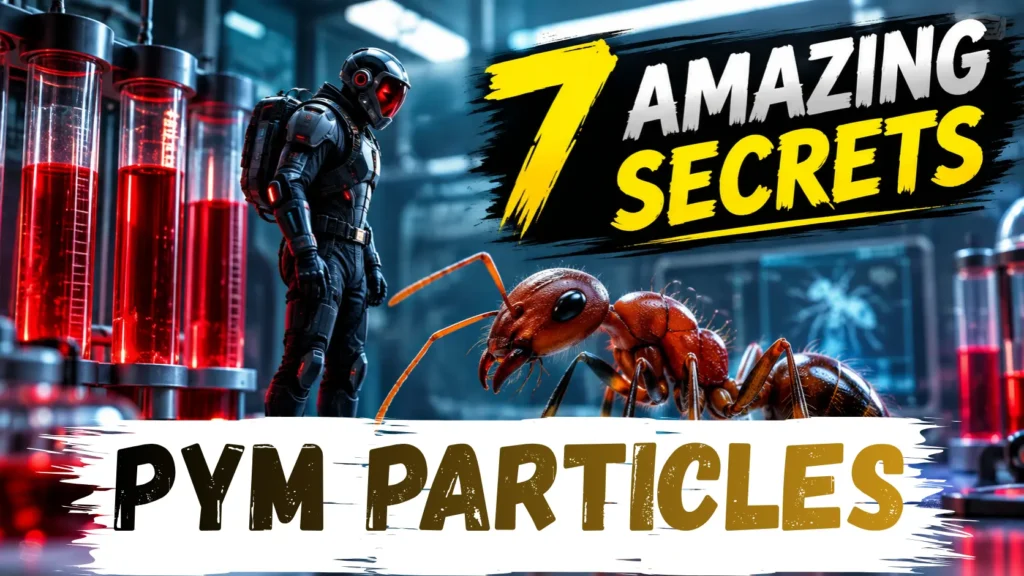
Imagine a technology that could shrink a human being to the size of an ant while allowing them to return to normal size in seconds. What if that same technology could make someone grow into a giant?
This is the central idea behind Pym particles, one of the most iconic fictional inventions in the Marvel Cinematic Universe (MCU).
In the Ant-Man movie, scientist Hank Pym discovers a way to manipulate the size of living organisms and non-living objects. His discovery becomes the foundation of Ant-Man’s suit, allowing heroes such as Scott Lang and Hope Van Dyne to shrink, grow, and explore environments beyond ordinary human experience.
But there’s a fascinating question behind all this: Could Pym particles, like any substance, work in real life? Although we know we can not shrink a living thing, is it possible to shrink a non-living thing?
1. What Are Pym Particles in Ant-Man?

Hank Pym’s Revolutionary Discovery
Pym particles are fictional subatomic particles discovered by Dr. Hank Pym, a brilliant scientist in the Marvel universe.
According to Marvel’s official character material, Hank developed the technology that allows him to change the size of any living or non-living object and created the Ant-Man suit. His discovery became the foundation for the shrinking and growing abilities seen throughout the franchise.
Rather than relying on ordinary mechanical tools like Iron Man, the technology changes the scale of the person or object using it.
In the MCU, Pym particles are used to:
- Shrink humans and objects to extremely small sizes. Even objects can shrink up to the quantum level.
- Restore shrunken objects to their original size.
- Allow certain users to grow into enormous forms, even much bigger than normal size.
- Help characters enter the Quantum Realm under special circumstances.
These abilities make Pym particles more than a simple shrinking ray. They are a fictional technology that changes how characters interact with the physical world.
Why Are They Named After Hank Pym?
The name comes from their fictional discoverer, Hank Pym.
He is not simply a superhero who happens to possess shrinking powers. He uses them during the Cold War. But he is the scientist responsible for developing the technology and understanding its dangers.
In the MCU, Hank is protective of his research because he knows that the invention could be dangerous if it fell into the wrong hands.
This concern becomes a major part of the first Ant-Man film, where Darren Cross attempts to reproduce and commercialize the technology.
Are Pym Particles a Chemical or a Machine?
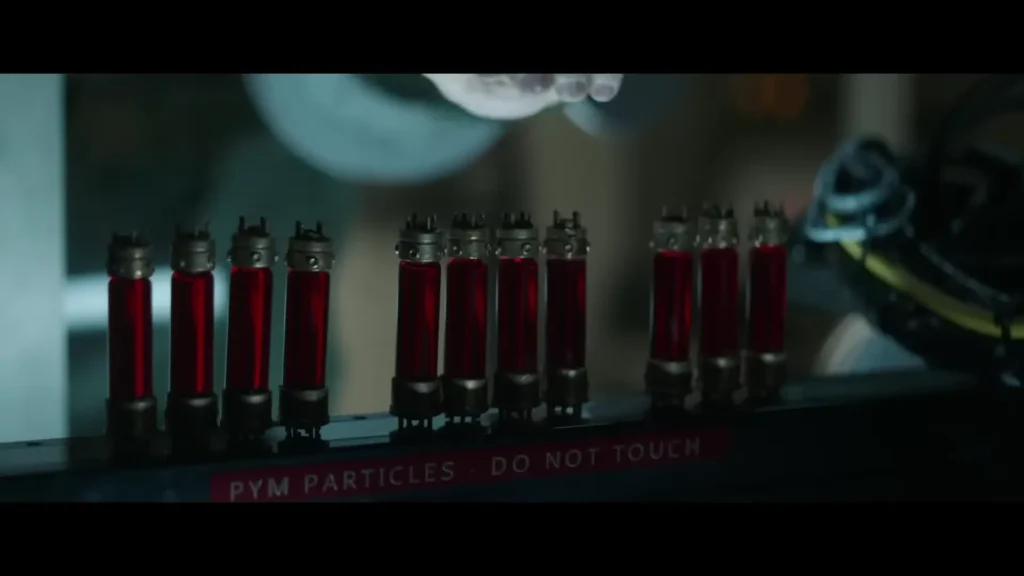
The films portray Pym particles as a scientific discovery that can be used through specialized equipment.
The Ant-Man suit and its control mechanisms help the wearer use the technology, but the particles themselves are not presented as an ordinary chemical or a conventional mechanical device.
Marvel does not provide a complete, scientifically testable explanation of their composition or behavior.
2. How Do Pym Particles Work in the MCU?
The Basic Principle: Changing Size
In the Marvel universe, Pym Particles work by manipulating the enormous amount of space within atoms. Although an atom contains a tiny, dense nucleus surrounded by electrons, most of its volume is effectively space.
Pym Particles are fictionalised as being able to reduce the distance between the particles that make up matter, pulling the atoms closer together without removing the matter itself. This allows an object or person to occupy far less physical space while retaining essentially the same mass.
In simple terms:
Pym Particles supposedly compress the microscopic gaps inside matter rather than simply squeezing the object from the outside, giving Ant-Man his extraordinary ability to shrink while remaining physically substantial.
Do Pym Particles Change Matter?
In the Marvel universe, Pym Particles do not simply destroy or create matter; they change how matter occupies space. The basic idea is that they manipulate the microscopic distances within matter, allowing the atoms to be brought closer together or separated farther apart.
When Ant-Man shrinks, the amount of matter and therefore his mass is supposedly retained, while the space occupied by that matter becomes dramatically smaller. When he grows, the process is reversed. This is a fictional mechanism, however, because real atoms cannot be compressed in this way while maintaining their normal structure, mass, and physical properties.
The Role of the Ant-Man Suit
The Ant-Man suit is designed to work in conjunction with Pym Particles, allowing the wearer to control when and how they shrink or grow. In the Marvel universe, the suit helps regulate the Pym Particles technology and protects the wearer during rapid changes in size.

Its helmet also provides life support and communication capabilities, which become especially important when operating at microscopic scales. The suit itself does not create the shrinking effect; Pym Particles are responsible for altering the wearer’s size, while the suit provides the technology and protection needed to control and survive the process.
The suit therefore combines several fictional technologies:
- Pym particle-based size alteration.
- Specialized controls for changing size.
- Protective equipment for the wearer.
- A helmet with anti-communication functions.
The result is a superhero system that combines size-changing abilities with insect-related technology.
3. Pym Particles, Mass, and the Laws of Physics
Pym Particles present one of the biggest challenges to real-world physics because shrinking an object without proportionally reducing its mass would violate several familiar physical principles.
In the Marvel universe, Pym Particles supposedly allow an object to become dramatically smaller while retaining much of its original mass, meaning a tiny Ant-Man could still weigh roughly as much as his normal-sized body.
In reality, if you compressed the atoms of a human body enough to make it that small, the enormous increase in density would create extreme physical and gravitational effects, while the atomic structure itself could not simply be squeezed together without changing its properties.
Therefore, Pym Particles provide a fictional solution to the mass–size problem that current physics has no known mechanism to achieve.
Does Ant-Man Keep His Original Mass?
In the Marvel universe, Ant-Man is generally portrayed as retaining his mass when he shrinks, which is one of the defining features of Pym Particle technology.
Although his body becomes much smaller, the Pym Particles supposedly allow his mass to remain largely unchanged, giving him the ability to strike with considerable force despite his tiny size.

This means that a shrunken Ant-Man can be extremely dense compared with an ordinary object of the same size. However, this concept does not fit Hnak Pym Tank keychain. Because if Tank’s mass were the same, no human could lift it like a toy.
So, retaining mass while changing size is best understood as a fictional property of Pym Particles rather than an established physical possibility.
Why Mass Matters When Shrinking
Mass matters when shrinking because changing an object’s size does not automatically mean its mass disappears.
In the Marvel universe, Pym Particles supposedly allow Ant-Man to become extremely small while retaining much of his original mass. This gives his tiny body a much higher density than an ordinary object of the same size, helping explain why he can still exert significant force despite being miniature.
In real physics, however, keeping the same mass while reducing a human’s volume enormously would make the body extraordinarily dense and would fundamentally alter its physical properties.
That mass–size relationship is one of the biggest scientific problems that Pym Particles are fictionalized to overcome.
Could Mass Be Stored Somewhere Else?
One possible fictional explanation for Pym Particles is that the mass of a shrinking object could somehow be transferred to or stored in another location or dimension, rather than remaining entirely within the smaller body.
Under this idea, when Ant-Man shrinks, the Pym Particles would move some of his mass into an external or extradimensional space, allowing his physical size to decrease without creating an impossibly dense body. When he returns to normal size, that mass would supposedly be restored.
4. The Ant-Man Suit: More Than Just a Shrinking Costume

A Suit Designed for Size-Changing
The Ant-Man suit is much more than a costume; in the Marvel universe, it is an essential part of controlling and safely using Pym Particle technology.
The suit works with the Pym Particles to regulate Ant-Man’s changes in size, while its helmet provides communication, protection, and environmental support during his missions.
It also helps him interact with ants through specialized technology, allowing him to communicate with and control them.
Most importantly, the suit provides a controlled interface for a technology that would otherwise be extremely difficult to use safely.
The Helmet and Ant Communication
The Ant-Man helmet plays an important role beyond protecting Scott Lang’s head.
In the Marvel universe, it contains advanced communication technology that allows Ant-Man to communicate with and influence ants, effectively enabling him to direct their movements and coordinate with them during missions.
The helmet also provides a sealed environment and supports communication while Ant-Man is operating at extremely small sizes.
5. Could Atoms Be Made Smaller?
Atoms have characteristic structures and sizes determined by quantum mechanics and electromagnetic interactions.
Changing the size of an atom is not the same as shrinking a person.
A human body contains an enormous number of atoms arranged into cells, tissues, organs, and complex biological systems.
A device that changed atomic structures throughout a living body would face fundamental questions about chemical bonds, biological function, energy, and stability.
Simply making the atoms smaller would not automatically preserve the body’s chemistry or life.
Could We Rearrange the Space Between Atoms?
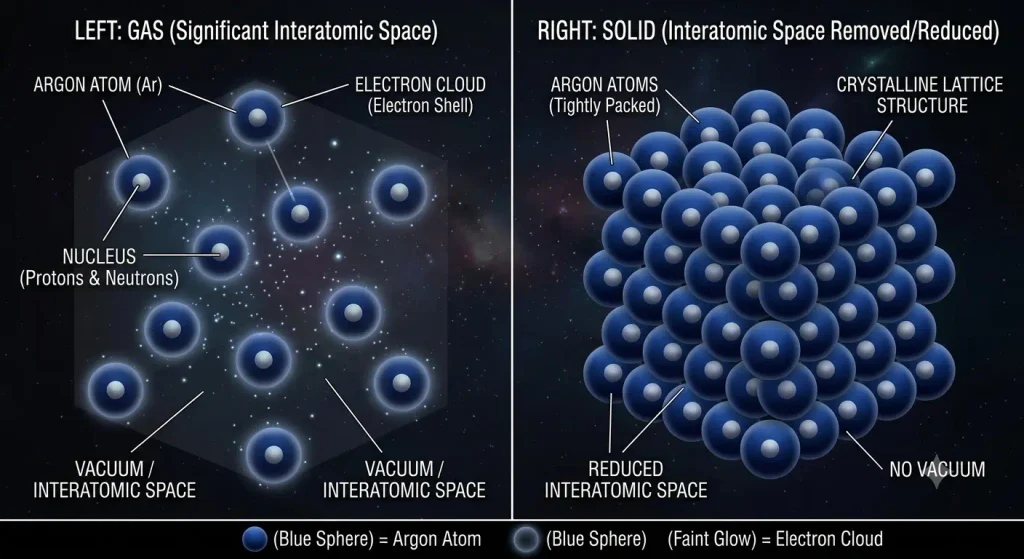
Another imagined explanation is that Pym particles compress the space between atoms.
But ordinary matter is not made of tiny solid balls with empty gaps that can be squeezed without consequences.
Atoms have quantum structures, and their interactions determine the properties of materials.
Compressing matter changes its density and physical state. Extreme compression can produce conditions very different from those needed to preserve a living human.
No known process can compress a human body to ant size and then restore it safely.
What About Nanotechnology?
Nanotechnology involves designing, studying, or manipulating structures at extremely small scales.
It has real applications in areas such as materials science, electronics, medicine, and engineering.
However, nanotechnology does not mean that scientists can shrink whole objects to microscopic sizes.
A nanoscale machine is not a miniature version of a human body with all the same organs and functions. It is a structure engineered to work at a small scale.
The central lesson is that real science can inspire imaginative storytelling without proving that the fictional technology is possible.
6. What Would Scientists Need to Discover to Create Pym Particles?
Creating technology like Pym particles would require discoveries far beyond anything currently available.
It would not be enough to invent a smaller machine or develop a new material. Scientists would need to understand how to change the physical scale of a living organism while preserving its structure and biological functions.
Challenge 1: Controlling Matter
A human body is made of many interacting systems, from individual atoms to complex organs.
A size-changing technology would need to account for these structures and their relationships. It would have to avoid damaging cells, disrupting chemical bonds, or interfering with the body’s essential functions.
No known particle or process can do this.
Challenge 2: Managing Mass and Energy
A shrinking or growing process would need to explain what happens to the body’s mass and energy.
If the body became smaller but retained its mass, its density would change dramatically. If its mass decreased, scientists would need to understand where that mass-energy went.
These are not minor engineering problems. They are fundamental questions about how the proposed technology would interact with physical laws.
Challenge 3: Keeping the Person Alive
A real human depends on a stable internal environment.
Blood circulation, breathing, temperature regulation, and the operation of organs all depend on biological structures working together.
A hypothetical size-changing process would need to preserve these functions during the transformation and after it ended.
Challenge 4: Reversing the Transformation
Even if scientists could produce a major change in size, they would still need a reliable way to reverse it.
The person would need to return to their original structure without suffering damage.
At present, there is no known scientific method for shrinking or enlarging a living human in this way.
The takeaway: Pym particles are not simply a futuristic invention waiting for better engineering. Their abilities depend on fictional assumptions about matter, mass, and size that have not been demonstrated in science.
7. Conclusion:
Pym particles are one of the most imaginative inventions in the Marvel Cinematic Universe.
They allow Ant-Man and other characters to shrink, grow, and explore the Quantum Realm, creating superhero adventures that would be impossible with ordinary technology.
But their abilities also raise important scientific questions. How could a body change size without being damaged? What happens to its mass? Could a person retain their strength after shrinking? And could a giant human remain physically stable?
Modern physics has no known technology that can achieve these transformations. Although Pym particles borrow ideas and terminology from science, their extraordinary abilities remain fictional.
That doesn’t make them less interesting. In fact, their appeal comes partly from the way they encourage us to think about the relationship between science, imagination, and the limits of what we currently understand.
The final takeaway: Pym particles are not a real scientific discovery, but they are a fascinating example of how Marvel uses science-inspired fiction to create a unique superhero technology.
8. Frequently Asked Questions About Pym Particles
1. What are Pym particles in Ant-Man?
Pym particles are fictional particles discovered by Hank Pym in Marvel. They enable size-changing technology, allowing characters such as Ant-Man to shrink and grow using specialized suits.
2. Are Pym particles real?
No. There is no verified scientific discovery of Pym particles. They are a fictional Marvel invention inspired by scientific ideas about particles and the structure of matter.
3. How do Pym particles work?
In the MCU, Pym particles enable dramatic changes in the size of people and objects. The films do not provide a complete scientific explanation of how the process works, and it cannot currently be reproduced using real-world physics.
4. Who invented Pym particles?
Dr. Hank Pym, a scientist in the Marvel universe, discovered Pym particles and developed the technology associated with the Ant-Man suit.
5. Can Pym particles make Ant-Man grow?
Yes. In the MCU, Ant-Man can use size-changing technology to grow into Giant-Man. The films portray this as another application of Pym particle technology.
6. Does Ant-Man keep his strength when he shrinks?
The films often portray Ant-Man as retaining useful strength while tiny. However, the exact relationship between his size, mass, and strength is not consistently explained in scientific terms.
7. Are Pym particles connected to the Quantum Realm?
Yes. In the MCU, extreme shrinking is connected to entering the Quantum Realm. This is a fictional setting and should not be confused with the real scientific study of quantum mechanics.
8. Can nanotechnology create something like Pym particles?
Not with current science. Nanotechnology can help scientists design and manipulate very small structures, but it cannot shrink a human being while preserving their biological functions. You can read more about Iron man nano technology of Mark 50.
9. Why are they called Pym particles?
They are named after Hank Pym, their fictional discoverer. His research forms the basis of the size-changing technology used by Ant-Man.
10. Are Pym particles the same in Marvel Comics and the MCU?
The central idea is similar, but explanations and details can differ. Comics and films may use different rules or descriptions, so it’s important to identify which version a claim refers to.
Image Credit: Screenshots from Ant-Man and related Marvel films are used for commentary, criticism, and educational purposes. © Marvel Studios / Marvel Entertainment. All rights reserved. No ownership of the original images is claimed.