

Can humans use 100% of their brain and could unlock the full potential of their brain?
That is the central idea behind Lucy (2014), the science-fiction action thriller directed by Luc Besson. The movie follows Lucy, played by Scarlett Johansson, after a mysterious drug called CPH4 enters her bloodstream.
According to the movie, CPH4 allows Lucy to access an increasing percentage of her brain. As the percentage rises, her abilities become more extraordinary.
She develops:
- 🧠 Extremely advanced intelligence
- ⚡ Faster reflexes and reactions
- 👁️ Enhanced perception
- 📚 Almost perfect memory
- 🧲 The ability to move objects with her mind
- 🧬 Greater control over her body
- ⏳ The ability to manipulate her perception of time
- 🌌 Eventually, abilities far beyond normal human biology
The movie presents all of this as if Lucy is gradually unlocking the 90% of her brain that humans supposedly don’t use.
But there is a major problem with this idea.
🧠 Humans don’t have a hidden 90% of the brain.
The famous claim that humans use only 10% of their brains is a scientific myth.
We actually use virtually all parts of the brain, although different areas become active at different times and during different tasks.
So what is real and what is fiction in Lucy?
Could humans really use 100% of their brain?
Is CPH4 a real substance?
Is CPH4 produced during pregnancy?
What exactly did the drug do to Lucy?
And could humans ever develop abilities similar to hers?
Let’s separate the science from the movie mythology.
🧠 Is It True That Humans Only Use 10% of Their Brain?
The idea that humans use only 10% of their brain is probably the most famous scientific misconception used in Lucy. The movie treats the brain almost like a computer with most of its processing power locked away. At 10%, Lucy is an ordinary human.
At 20%, she becomes smarter and more capable.
At higher percentages, she develops abilities that appear almost supernatural.
At 100%, she supposedly transcends normal human existence.
It sounds scientific.
But the human brain doesn’t work like this.
🔬 Where Does the 10% Myth Come From?
There isn’t one confirmed person who invented the 10% claim.
The idea became popular through a mixture of:
- 📰 Misinterpretations of early neuroscience
- 🧠 Misunderstandings about brain function
- 📚 Popular books and self-help claims
- 🎬 Movies and television
- 🗣️ Repeated claims in popular culture
Eventually, the statement became so widespread that many people assumed it was established science. It isn’t.
🧠 Do We Actually Use Our Whole Brain?
Yes—but there is an important distinction.
Using the whole brain does not mean every neuron is active at maximum intensity at the same moment.
Different parts of the brain perform different jobs.
For example:
- 👁️ Visual areas process information from your eyes.
- 👂 Auditory areas process sounds.
- 🖐️ Sensory regions process information from your body.
- 🦵 Motor regions help control movement.
- 🧠 Memory-related networks help store and retrieve information.
- 🗣️ Language networks help us understand and produce speech.
- ❤️ Other brain systems help regulate emotions, motivation and behavior.
Even simple activities can involve many interconnected brain networks.
😴 What About When We Sleep?
This is another reason the 10% idea doesn’t make sense. When you sleep, your brain doesn’t simply switch off.
The sleeping brain continues performing important functions involving:
- Memory processing
- Learning
- Regulation of biological processes
- Neural activity
- Coordination with other body systems
So your brain remains highly active even when you’re lying in bed unconscious.
⚡ Does That Mean 100% of Our Neurons Are Active at Once?
No.
This is where the phrase “we use 100% of our brain” can become misleading. Your brain contains billions of neurons connected into incredibly complex networks.
Different neurons and networks become active depending on:
- What you’re seeing
- What you’re hearing
- What you’re thinking
- What you’re remembering
- What you’re feeling
- What you’re doing physically
There is no biological reason for every neuron to fire simultaneously. In fact, uncontrolled or excessive neural activity can be harmful. So the real situation is more interesting than the movie’s simple percentage scale:
We use the entire brain, but different parts are recruited to different degrees depending on the task.
There isn’t a giant unused section waiting for scientists to activate.
🎬 How Lucy Uses the 10% Myth
This is where the movie becomes clever storytelling.
Instead of treating intelligence as a complicated network of neurons, Lucy turns brain activity into a simple progression.
The movie’s fictional progression:
10% → Normal human
⬇️
20% → Enhanced abilities
⬇️
40% → Extraordinary intelligence
⬇️
60%+ → Superhuman abilities
⬇️
100% → Transcendence
This gives the audience a simple visual explanation for Lucy’s transformation.
But there is no scientific measurement called “percentage of brain unlocked.”
A person doesn’t become 30% smarter because their brain suddenly reaches 30% usage.
Intelligence is influenced by many factors, including:
- 🧬 Genetics
- 🧠 Neural organization
- 📚 Education
- 🧩 Learning
- 🧠 Memory
- ⚡ Processing efficiency
- 💤 Sleep
- 🏃 Physical health
- 🌎 Environment and experience
The brain is not a machine with a hidden 100% power setting.
🔬 So Can Humans Use 100% of Their Brain?

If by “100%” you mean using all major parts of the brain, then yes—we already do.
If you mean activating every neuron simultaneously at maximum power, then no—and that wouldn’t give us superpowers anyway.
This is one of the biggest differences between real neuroscience and Lucy.
🧠 Movie idea:
More brain activity = more power
🔬 Scientific reality:
Different neural networks = different functions
The real potential of the brain comes from how efficiently its networks communicate, adapt and learn—not from unlocking a hidden percentage.
And this brings us to the next mystery in Lucy: the substance responsible for her transformation.
🧪 Is CPH4 a Real Substance?
One of the biggest mysteries in Lucy is the drug called CPH4.
In the movie, CPH4 is described as a substance naturally produced by pregnant women during the early stages of fetal development. The movie suggests that it provides enormous energy to a developing fetus.
Lucy is exposed to a synthetic version of CPH4, and this supposedly unlocks increasing levels of her brain’s potential.
But there is an important distinction:
🎬 CPH4 in Lucy is fictional.
There is no known drug called CPH4 that can unlock hidden brain capacity or give humans superhuman abilities.
The movie uses scientific-sounding terminology to create a believable explanation for Lucy’s transformation.
🤰 Is CPH4 Really Produced During Pregnancy?
This is one of the most common questions people have after watching Lucy.
The short answer is: No
There is no established biological substance called CPH4 that pregnant women produce during the sixth week of pregnancy in the way described by the movie.
The film presents CPH4 as if it were an important natural substance involved in fetal development.
However, this isn’t an accepted explanation of human pregnancy or fetal development.
🔬 Where Does the Confusion Come From?
The name CPH4 appears to have been created for the movie and sounds like a biochemical abbreviation. There are real molecules and enzymes with chemically similar names.
For example, 6-carboxytetrahydropterin synthase is a real enzyme involved in biochemical pathways in certain organisms.
But this doesn’t make it the same substance as the fictional CPH4 from Lucy.
More importantly, there is no evidence that this compound acts as a pregnancy hormone that gives a developing fetus extraordinary energy or brain power.
💊 What Did the Drug Do to Lucy?
This is where Lucy moves from biology into pure science fiction. At the beginning of the movie, Lucy is an ordinary human being. After CPH4 enters her bloodstream, the movie shows her abilities increasing rapidly.
🧠 Stage 1: Enhanced Cognitive Abilities
Lucy begins experiencing extraordinary changes in her mental abilities.
She becomes capable of:
- 📚 Absorbing information extremely quickly
- 🧠 Remembering details with incredible accuracy
- 🔍 Understanding complex situations
- 🗣️ Learning languages rapidly
- ⚡ Processing information at extraordinary speed
Some of these abilities are exaggerated versions of things the human brain can actually do. Humans already have remarkable abilities to learn, remember and recognize patterns. But there is no known drug that can suddenly transform someone into Lucy.
👁️ Stage 2: Enhanced Perception
As Lucy’s supposed brain percentage increases, she begins perceiving the world differently. She can notice details that ordinary humans might miss. The movie portrays her brain as processing information at an extraordinary rate.
🔬 Is This Completely Impossible?
The brain really does filter enormous amounts of sensory information. Your eyes, ears, skin and other sensory systems constantly send information to your nervous system. However, our conscious attention has limits. We cannot simply take a drug and switch off all those limitations.
Lucy is therefore taking a real neurological concept—sensory processing—and pushing it to a fictional extreme.
⚡ Stage 3: Extreme Physical Control
Lucy eventually gains unusual control over her body.
She can control things such as:
- Pain perception
- Muscle responses
- Internal bodily functions
- Physical reactions
The human brain really does control many processes inside the body.
The nervous system communicates with muscles, organs and other tissues.
Some bodily functions can also be influenced indirectly through training, breathing techniques and other methods.
But Lucy’s level of control goes far beyond anything demonstrated in normal human biology.
🧲 Stage 4: Telekinesis
This is where the movie leaves neuroscience behind. Lucy eventually becomes capable of moving physical objects using her mind.
This ability is known as telekinesis or psychokinesis.
❌ Can Humans Actually Do This?
There is no reliable scientific evidence that humans can directly move physical objects through thought alone.
Your brain produces electrical and chemical signals, but these signals don’t generate a mysterious force capable of pushing objects around a room.
However, modern technology has created something that can look surprisingly similar.
🤖 Brain-Computer Interfaces
A Brain-Computer Interface (BCI) can detect certain patterns of brain activity and translate them into commands.
This technology has been investigated for controlling:
- 🦾 Robotic arms
- 🦿 Prosthetic devices
- 💻 Computer cursors
- 🖥️ Digital interfaces
- 🦽 Assistive technology
The process is very different from telekinesis.
Lucy:
🧠 Brain → Object
Real BCI:
🧠 Brain → Sensors → Computer → Machine → Object
The machine is doing the physical work.
Still, the idea of controlling technology through neural signals is completely real—and it’s one of the most fascinating areas of modern neuroscience.
⏳ Stage 5: Manipulating Time
As Lucy approaches the highest levels of her fictional brain capacity, she appears to gain control over time.
She can perceive events in unusual ways and eventually seems capable of manipulating matter and time itself.
🧠 Can the Human Brain Control Time?
Not physical time.
But there is an interesting scientific distinction.
Our perception of time can change.
For example:
- 😨 During a frightening event, time can appear to slow down.
- 😴 During sleep, our perception of time changes.
- 🎮 During an engaging activity, hours can seem to pass quickly.
- 😑 During boredom, a few minutes can feel much longer.
This happens because the brain constructs our experience of time. But changing your perception of time isn’t the same as physically changing time.
🎬 Lucy takes the concept much further.
The movie essentially asks:
What if a mind became so advanced that it could interact with reality itself?
That’s an exciting science-fiction question—but there is currently no scientific evidence that a human brain could control spacetime.
🌌 What Happens to Lucy at 100%?
The final stage of Lucy’s transformation is perhaps the most philosophical part of the movie.
Lucy doesn’t simply become an extremely intelligent human. Instead, she appears to transcend her biological body and becomes something closer to information or pure consciousness. This idea isn’t established neuroscience.
We don’t currently know whether human consciousness can exist independently of the biological brain.
🔬 Science Fiction or Future Possibility?
Some researchers and philosophers have explored ideas involving:
- 🧠 Digital consciousness
- 💻 Whole-brain emulation
- 🤖 Artificial intelligence
- 🧬 Human-machine integration
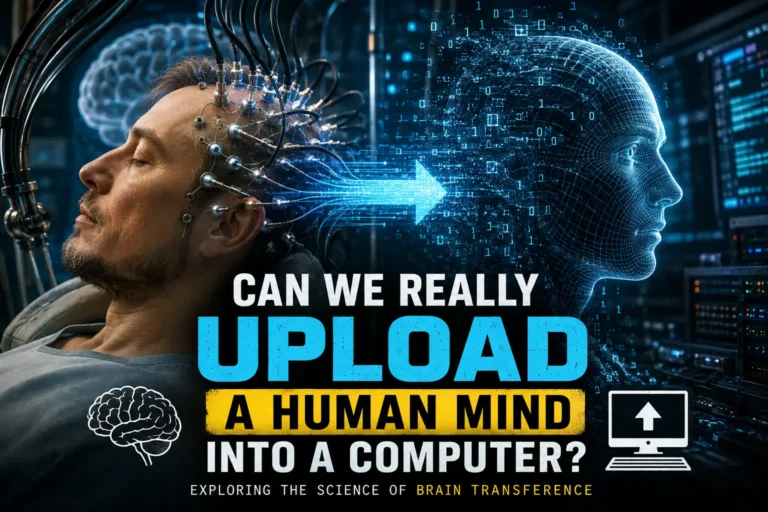
- 🌐 Mind uploading
But these remain highly speculative.
We don’t currently have a method for transferring a human consciousness into a computer.
So Lucy’s final transformation should be viewed as science fiction rather than a prediction of future neuroscience.
🧠 Does the Human Brain Have a Limit?
This is actually a much more interesting scientific question than the 10% myth.
The human brain clearly has limitations.
We have limited:
- 🧠 Working memory
- 👁️ Attention
- 📚 Recall
- ⚡ Processing speed
- 😴 Energy
- 🧬 Biological resources
But the brain is also incredibly adaptable.
This ability is known as neuroplasticity.
🧬 Neuroplasticity: The Real Brain Upgrade
Neuroplasticity is the brain’s ability to change and adapt in response to experience, learning and environmental demands.
For example:
🎸 Learning an Instrument
Your brain must coordinate:
- Hearing
- Memory
- Movement
- Timing
- Attention
Repeated practice strengthens and reorganizes the neural systems involved.
🗣️ Learning a Language
Learning another language involves memory, attention, auditory processing and language networks.
🏃 Physical Exercise
Regular physical activity can support brain health and cognitive function.
😴 Sleep
Sleep plays an important role in memory, learning and normal brain function.
None of this means that you’re unlocking another percentage of your brain.
Instead, you’re making better use of the brain you already have.
🔬 The Real Lesson Behind Lucy
The most interesting thing about Lucy isn’t whether humans can reach 100%.
We already use our brains extensively.
The fascinating question is:
How much can the human brain improve through learning, adaptation and technology?
That question has a real scientific foundation.
Researchers are studying:
- 🧠 Neuroplasticity
- 🤖 Brain-computer interfaces
- 🧬 Neural prosthetics
- 💻 Artificial intelligence
- 🔬 Brain stimulation
- 🧠 Cognitive neuroscience
The future may allow humans to interact with machines in ways that currently look like science fiction.
But we probably won’t get there by unlocking a mysterious 90% of our brain.
We’ll get there by understanding the 100% we already have.
🧬 What Human Is Lucy?
Another interesting question surrounding the movie is:
What kind of human is Lucy?
At the beginning of the movie, Lucy is an ordinary modern human being.
She isn’t introduced as:
- 👽 An alien
- 🧬 A genetically modified human
- 🦸 A mutant
- 🤖 A cyborg
- 🧪 A different species
She is simply a normal human woman.
Her transformation happens after she is exposed to the fictional drug CPH4.
The movie then uses the idea of increasing brain capacity to explain her evolution into something far beyond an ordinary human.
🧠 Is Lucy Becoming a New Species?
Not scientifically.
The movie uses the word evolution in a very loose, fictional sense.
In real biology, evolution doesn’t happen to an individual because they take a drug.
Evolution happens across populations over generations, as genetic changes are passed from one generation to another and influenced by factors such as natural selection, mutation and genetic drift.
Lucy doesn’t biologically evolve into a new species within a few hours.
Her transformation is a science-fiction interpretation of human evolution.
🧬 Do We Have Lucy’s DNA?
No special form of “Lucy DNA” exists that could give humans the abilities shown in the movie.
Lucy is genetically human.
The movie doesn’t establish that she has a unique genome that gives her supernatural abilities.
Her abilities supposedly come from the fictional effects of CPH4 and the increasing percentage of brain usage.
🔬 Could DNA Make Someone Superhuman?
Genes absolutely influence many characteristics of the human body.
They can affect things such as:
- 🧬 Physical characteristics
- 🧠 Some aspects of brain development
- 💪 Muscle-related traits
- 👁️ Eye characteristics
- 🧪 Metabolism
- 🧠 Susceptibility to certain conditions
But there is no known human gene that gives someone telekinesis or allows them to manipulate time.
Complex abilities such as intelligence are influenced by many genes as well as environment and experience.
So there isn’t a hidden piece of DNA waiting to turn someone into Lucy.
🥑 Is Our Brain 60% Fat?
You may also come across another interesting claim:
“The human brain is 60% fat.”
There is some truth behind the statement, but it needs context.
The brain contains a large amount of lipids (fats), which are important components of cell membranes and myelin.
🧠 Why Does the Brain Need Fat?
Fat is important for several reasons.
It contributes to:
- ⚡ Neural signaling
- 🧬 Cell membranes
- 🧠 Myelin around nerve fibers
- 🔋 Energy-related processes
- 🧠 Normal brain structure and function
However, saying simply that “your brain is 60% fat” can be misleading because the exact percentage depends on how the measurement is defined and what is being measured.
So the better takeaway is:
The brain is exceptionally lipid-rich, but the popular “60% fat” statement shouldn’t be interpreted as meaning that 60% of your entire brain is simply stored body fat.
This is another example of how a scientific fact can become oversimplified when it enters popular culture.
🔬 Lucy Movie: Science vs Fiction
So how much of Lucy is actually supported by science?
Let’s break down the biggest claims.
| 🧠 Movie Claim | 🔬 Scientific Reality |
|---|---|
| Humans use only 10% of their brain | ❌ Myth |
| Humans can unlock the remaining 90% | ❌ No hidden 90% exists |
| CPH4 dramatically increases brain capacity | ❌ Fiction |
| CPH4 is produced during pregnancy as shown | ❌ Not established science |
| A drug can make someone super-intelligent within hours | ❌ No evidence |
| Humans can move objects with thoughts alone | ❌ No reliable evidence |
| Brain-computer interfaces can translate neural signals into commands | ✅ Real technology |
| The brain can change through learning | ✅ Neuroplasticity |
| Exercise and sleep support brain health | ✅ Supported by research |
| The brain can perceive time differently | ✅ Real |
| The brain can physically control time | ❌ Fiction |
| Humans can upload consciousness into computers | ❓ Speculative |
| A person can become pure information | ❌ Science fiction |
The movie therefore combines real neuroscience, scientific terminology and completely fictional ideas.
That combination is what makes Lucy so entertaining.
❓ Frequently Asked Questions About Lucy
🧠 Can humans use 100% of their brain?
Humans already use virtually all parts of the brain over time. However, different brain regions and neural networks are active at different levels depending on what we’re doing.
The idea that 90% of the brain is completely unused is a myth.
🧠 Is it true that humans only use 10% of their brain?
No.
Modern neuroscience does not support the idea that humans use only 10% of their brains.
Different parts of the brain perform different functions, and virtually all major regions have roles.
🧪 Is CPH4 a real substance?
CPH4 as portrayed in Lucy is fictional.
There are real biochemical molecules and enzymes with similar-sounding names, but there is no known substance that can unlock 90% of the human brain or give someone Lucy’s abilities.
🤰 Is CPH4 really produced during pregnancy?
No scientific evidence supports the movie’s claim that pregnant women naturally produce CPH4 during the sixth week of pregnancy as a powerful energy source for fetal development.
The movie uses fictional biology to explain Lucy’s transformation.
💊 What did the drug do to Lucy?
In the movie, CPH4 dramatically increases Lucy’s cognitive and physical abilities.
She develops extraordinary memory, perception, intelligence and control over her body before gaining fictional abilities such as telekinesis and matter manipulation.
🧬 What human is Lucy?
Lucy is an ordinary modern human at the beginning of the movie.
She isn’t an alien or a genetically different species.
Her transformation is caused by the fictional effects of CPH4.
🧬 Do we have Lucy’s DNA?
No.
Lucy doesn’t possess a scientifically established form of “superhuman DNA.”
Her abilities are fictional and aren’t explained by a special genetic mutation.
🧠 Does the human brain have a limit?
Yes.
The brain has biological limitations involving energy consumption, memory, attention, processing and physical structure.
However, neuroplasticity allows the brain to adapt and improve certain abilities through learning and experience.
🥑 Is the human brain 60% fat?
The brain is extremely rich in lipids, but the statement that the brain is simply “60% fat” is an oversimplification.
The exact figure depends on how brain composition is measured.
⚡ Can humans develop Lucy’s powers?
There is currently no scientific evidence that humans can develop telekinesis, control time or manipulate matter with their minds.
However, technologies such as brain-computer interfaces can allow neural activity to control external devices.
That is real science—not telekinesis.
⭐ Final Verdict: Is Lucy Scientifically Possible?
Lucy is a fascinating example of how science fiction can take a real scientific question and push it to an impossible extreme.
The movie asks:
What would happen if a human could access the full potential of the brain?
The scientific answer is very different from the movie. There isn’t a hidden 90% of the brain waiting to be activated. There is no known CPH4 drug capable of transforming a person into a superhuman. And there is no evidence that increasing brain activity would give humans telekinesis, time manipulation or control over matter.
But the real brain is already extraordinary.
🧠 It can learn.
🧬 It can adapt.
💭 It can create memories.
🎨 It can imagine things that don’t exist.
🤖 And increasingly, it can communicate with machines.
That’s perhaps more fascinating than the fictional 100% brain theory.
🚀 The Future Isn’t About Unlocking 90%
The real future of human intelligence may come from combining our existing biological abilities with technology. Brain-computer interfaces, artificial intelligence, neuroscience and neurotechnology could eventually change how humans interact with computers and machines.
So the biggest lesson from Lucy isn’t:
“Humans only use 10% of their brains.”
It’s this:
We don’t need to unlock a hidden 90%. We need to understand the remarkable 100% we already have.
And that’s where the real science becomes almost as fascinating as the movie.
Movie screenshots from Lucy (2014) are used for commentary, criticism, review, and educational purposes. All rights to the screenshots belong to their respective copyright holders. No copyright ownership is claimed.
Read More Articles:
Simulation Hypothesis Explained: Like The Matrix Movie?
Is Avatar’s Planet Pandora Scientifically Possible? Explaned
Could a Super Soldier Serum Like Captain America’s Exist?


This is awesome blogs i had ever seen. love your post