
Christopher Nolan’s Oppenheimer, winner at the Golden Globe Awards, is not a typical action-packed sci-fi film which is based upon history of atomic bomb. Instead, it dives deep into one of the most important scientific events in human history — the creation of the atomic bomb.
Golden Globe Winner Oppenheimer: How Accurate Is the Nuclear Science Shown in the Movie?
The movie focuses on J. Robert Oppenheimer, the physicist who led the Manhattan Project. But an important question arises:
How accurate is the nuclear science shown in Golden Globe winner Oppenheimer Science?
Let’s break this movie myth using real physics and historical science using Golden Globe Winner Oppenheimer science.
☢️ What Is the Manhattan Project?
The Manhattan Project was a secret scientific program during World War II aimed at building the world’s first nuclear weapon. This program was led by the United States with United kingdom and canada. Golden Globe Winner Oppenheimer science is a master piece based on this history. The project was initially start in 1942, By U.S. Army corps of Engineers Brigadier General Leslie Groves and theoretical physicist J. Robert Oppenheimer.

Real image of : J. Robert Oppenheimer
Project hired nearly 130,000 people across the all sites and cost approximate $2 billion. equivalent to about $28 billion on this date.
The movie shows: Golden Globe Winner Oppenheimer science
- Intense theoretical calculations
- Massive industrial-scale experiments
- Extreme secrecy
Science Check ✅
All of this is historically and scientifically accurate.
Thousands of real scientists worked on:
- Scientists developed two core designs-
- GUN TYPE: Used for the uranium bomb, Little Boy it involved shooting one sub critical piece of U-235 into another form of critical mass.
- Implosion type: Used for the plutonium bomb, This was a complex design involve using precisely timed explosives to compress a sub-critical plutonium core into a critical state.
⚛️ Nuclear Fission Explained
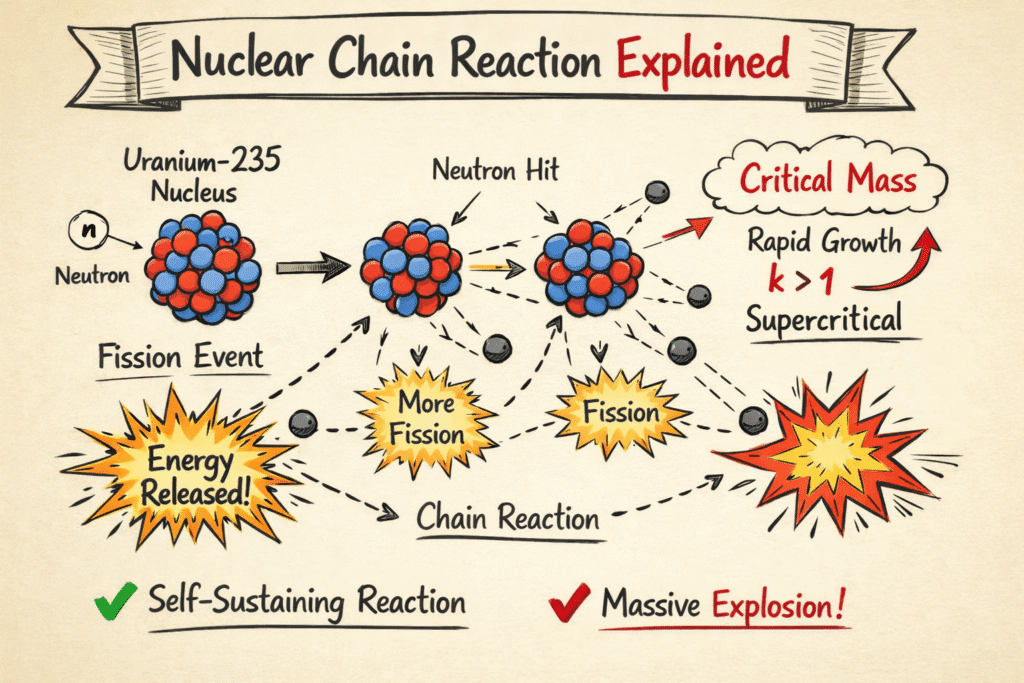
Nuclear fission is a process that exploits the instability of certain heavy isotopes, like Uranium-235 or Plutonium 239.
1. Initiation
The reaction begins when a free neutron is fired into (or spontaneously collides with) the nucleus of a fissile atom, such as Uranium-235.
2. Splitting (Fission)
The absorption of this neutron makes the nucleus highly unstable. It immediately splits into two or more smaller, lighter nuclei (called fission products, such as Barium and Krypton).
3. Energy and Neutron Release
This splitting releases a massive amount of binding energy (governed by Einstein’s equation, E=mc2 and, crucially, releases an average of two to three new free neutrons.
4. The Chain Reaction (Exponential Growth)
In a nuclear weapon, the design ensures that this newly released handful of neutrons does not escape or get absorbed by non-fissile material. Instead, each new neutron strikes another nearby fissile nucleus, causing it to split and release more neutrons.
This multiplication happens exponentially in a tiny fraction of a second. This rapid, uncontrolled reaction consumes a large amount of the fissile material and releases a devastating amount of energy, creating the nuclear explosion.
🔬 Why Nuclear Weapons Need a Critical Mass (Explained Simply)
1️⃣ Why a Critical Mass Is Required
The idea of critical mass is the foundation of nuclear fission weapons.
In a nuclear reaction, atoms split and release neutrons. These neutrons then hit other atoms, causing a chain reaction.
The key factor here is the neutron multiplication factor (k):
- k < 1 → reaction dies out
- k = 1 → reaction is stable (critical)
- k > 1 → reaction grows rapidly (supercritical)
💥 For an explosion, the material must become highly supercritical, where each fission creates many more fissions in a very short time.
🔹 Why Size and Shape Matter
Every piece of fissile material loses neutrons because some escape from its surface.
Here’s the important physics:
- Fissions happen inside the volume (∝ r³)
- Neutrons escape from the surface (∝ r²)
As mass increases:
- Neutron production increases faster than neutron loss
👉 A critical mass is simply the minimum amount needed so that more neutrons are created than lost.
Below this mass, the reaction stops instantly.
💥 Why Uncontrolled Reactions Cause Explosions
An atomic bomb works by creating a prompt supercritical reaction.
This leads to an explosion for two reasons:
⚡ 1. Exponential Chain Reaction
In a supercritical state, the number of neutrons doubles repeatedly in incredibly short time intervals — measured in nanoseconds.
The reaction grows faster than the material can physically react.
🔥 2. Energy Is Released Too Fast
The energy from fission is released:
- Before the core can expand
- Before heat can escape
This creates:
- Enormous pressure
- Extreme temperatures
💣 The result is a powerful blast wave.
The explosion stops only when the core expands enough that it becomes sub-critical again and neutrons start escaping.
⏱️ Why Timing and Geometry Matter (The Implosion Problem)
This was the hardest challenge faced during the Manhattan Project, especially for the Plutonium bomb.
🧪 The Plutonium Problem
Plutonium-239 is an excellent fuel, but it contains traces of Plutonium-240, which:
- Undergoes spontaneous fission
- Constantly releases stray neutrons
This creates a serious risk.
🚫 Why Simple Designs Failed
A slow assembly method (like the uranium gun-type bomb):
- Allows stray neutrons to start the reaction too early
- Causes pre-detonation or a “fizzle”
- Results in a weak explosion
The bomb must assemble faster than the neutrons can react.
🌀 The Implosion Solution (Perfect Timing + Geometry)
To solve this, Oppenheimer’s team developed the implosion design:
- High-explosive lenses create a perfectly symmetrical shockwave
- This shockwave compresses the plutonium core inward
- Compression happens in less than 40 nanoseconds
🔬 Compression increases density, and since:
Critical mass decreases rapidly as density increases
the material becomes supercritical almost instantly.
This precise timing and geometry made a full nuclear explosion possible.
🧠 Why This Matters in Oppenheimer
The movie correctly shows:
- The importance of critical mass
- The fear of premature detonation
- The obsession with timing and symmetry
👉 These were real scientific problems, not cinematic exaggerations of Golden Globe Winner Oppenheimer science.
💥 Trinity Test – Could It Really Destroy the World?
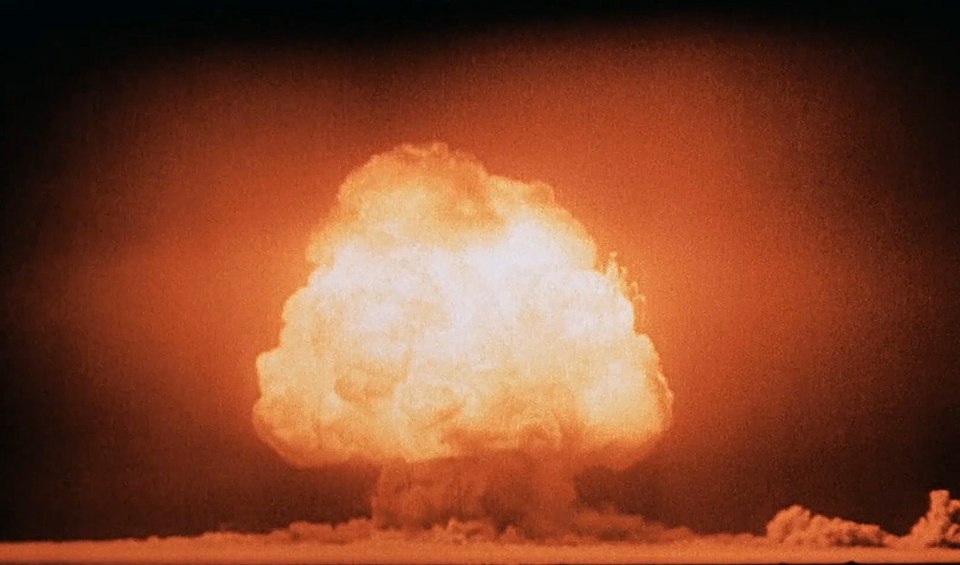
In the movie Golden Globe Winner Oppenheimer science, scientists fear the first nuclear test (Trinity Test) might ignite Earth’s atmosphere.
Science Reality:
- This fear was briefly discussed in real history
- Scientists quickly calculated it was theoretically impossible
Accuracy Check ⚠️
✔️ Fear was real
❌ Actual danger was not
Nolan accurately shows the psychological tension, not scientific error. so it was shown in Golden Globe Winner Oppenheimer science.
🔊 Why Is There No Sound During the Explosion?
One of the most powerful scenes shows the nuclear explosion without sound at first in Golden Globe Winner Oppenheimer science.
Science Behind It ✅
- Light travels faster than sound
- The shockwave arrives later
This is perfectly accurate physics and one of the most realistic explosion scenes ever filmed.
🧠 Does the Movie Over-Simplify Science?
Yes — but intentionally.
Why?
- Real nuclear physics involves advanced mathematics
- Movies must simplify concepts for storytelling
⚠️ The principles are accurate, but details are simplified in Golden Globe Winner Oppenheimer science.
🎬 Movie vs Science Comparison
| Concept | Accuracy |
|---|---|
| Nuclear fission basics | ✅ Accurate |
| Chain reaction theory | ✅ Accurate |
| Trinity Test visuals | ✅ Very accurate |
| Atmosphere ignition fear | ⚠️ Exaggerated |
| Sound delay in explosion | ✅ Perfect |
🧠 Final Verdict: Movie Myth Broken?
Oppenheimer stands out as one of the most scientifically accurate films ever made. While some fears and dialogues are dramatized, the core nuclear science is real and well-presented.
👉 Golden Globe winner Oppenheimer respects real science more than most Hollywood films. Golden Globe Winner Oppenheimer science is a master piece.
📸 Image Credit Note
Image Credit: Screenshots belong to Universal Pictures. Used under fair use for educational and review purposes.
🔗 Related Posts
Could the Multiverse Actually Exist According to Modern Science?