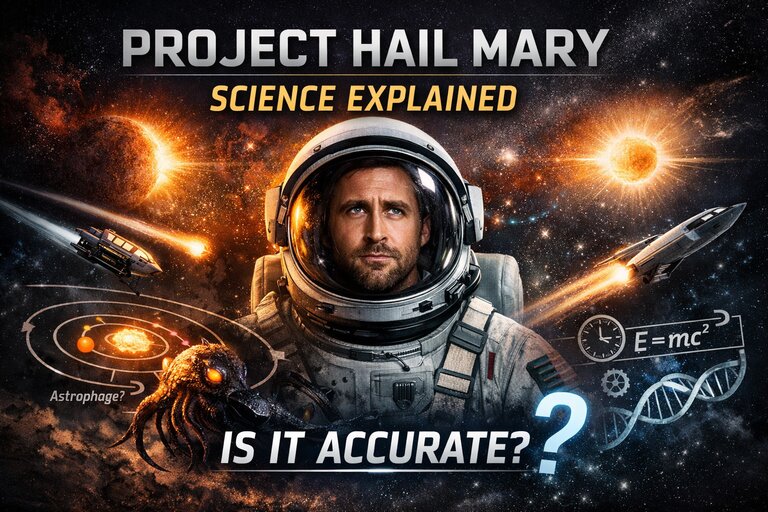

Dune movie explained in the simplest way — but not just the story. In this article, we explore the real science behind Dune, including spice, sandworms, and futuristic technology.
The world of Dune has recently exploded in popularity again, but beyond its stunning visuals and powerful storytelling lies something even more fascinating — science.
Frank Herbert’s Dune isn’t just a masterpiece of space opera; it’s a detailed study of ecology, human potential, and planetary science. With the massive success of the recent films, everyone is asking the same thing: Could the world of Dune actually exist?
Let’s break down the real science behind Dune.
Before deep diving into the science behind Dune watch trailer: Dune Part 3
🧪 1. What is “Spice” — Could It Exist in Real Life?
In Dune, “Spice” (Melange) is the most valuable substance in the universe. It can: Dune movie explained
- Extend human life
- Enhance mental abilities
- Enable limited future prediction
The Science: We don’t have a single “super-drug,” but we do have Nootropics (cognitive enhancers) and adaptogens. Compounds like Metformin or Rapamycin are currently being studied by biohackers and scientists for their anti-aging properties.
The Reality Check: While we have substances that can alter perception (psychedelics) or improve focus, a substance that allows you to see through time is firmly in the realm of fiction. However, the search for a “longevity pill” is a multi-billion dollar real-world industry..
🧠 2. Can Humans Really Predict the Future?
Paul Atreides’ visions are a core part of the story. He can see possible futures and make decisions accordingly. Dune movie explained
The Science: We call this Predictive Modeling. Today, Big Data and AI do exactly what Paul does. They analyze weather patterns, stock market fluctuations, and consumer behavior to “predict” what happens next.
The Reality Check: Humans can’t see the future through visions, but our prefrontal cortex is designed to simulate future scenarios. We are “prediction machines” by nature; Paul is just the ultimate version of that biological trait.
We don’t have “visions,” but advanced prediction systems are getting closer to this idea.
🏜️ 3. Sandworms — Could Giant Creatures Like This Exist?
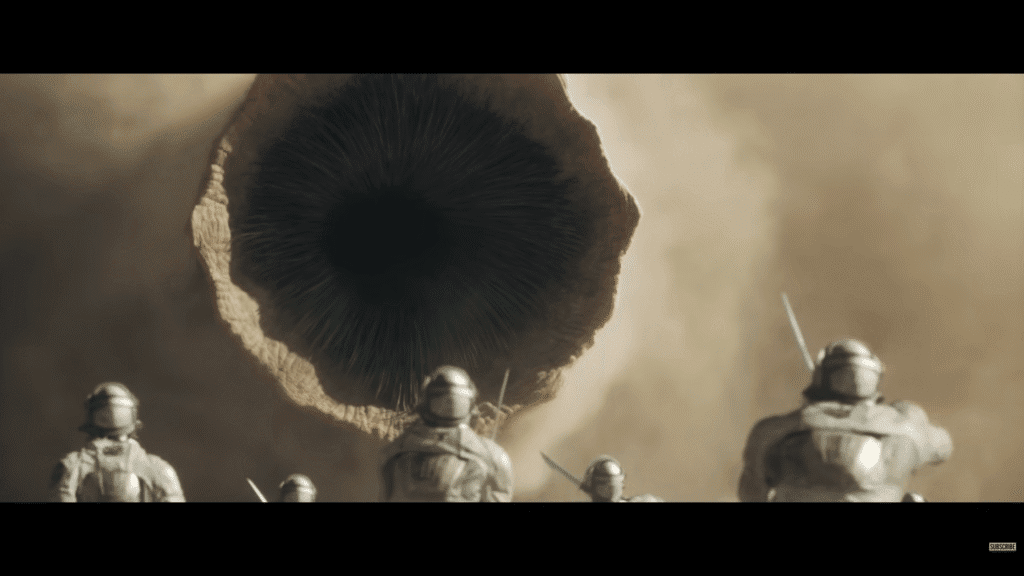
The massive sandworms are one of the most iconic elements of Dune. Dune movie explained
The Science: On Earth, we have extremophiles—organisms that live in volcanic vents or deep underground. However, the “Square-Cube Law” in biology suggests that a creature as large as a Sandworm would collapse under its own weight or overheat instantly.
The Reality Check: While a 400-meter worm is unlikely, the concept of a “thumper” (using rhythmic vibrations to attract life) is a real biological tactic used by some predators on Earth, like certain species of moles and snakes.rge are scientifically unlikely, but smaller underground life forms are very real.
🚀 4. Space Travel Without Computers — Is It Possible?
In Dune, humans replace computers due to a historical ban on AI. Specially trained humans perform complex calculations. Dune movie explained
The Science: The human brain is still the most energy-efficient “computer” in existence. We are currently seeing a rise in Neuroplasticity research, showing that humans can train their brains to perform incredible feats of calculation and memory (like “memory athletes”).
The Reality Check: As we become more dependent on AI (like ChatGPT!), Dune serves as a cautionary tale. Could we survive without our devices? Scientifically, our brains have the capacity, but the “processing speed” would never match silicon.
This idea is fascinating but impractical in real-world science.
⚡ 5. Shield Technology — Could Energy Shields Work?
In Dune, personal shields (the Holtzman Effect) create a flicker of blue light that stops bullets and fast projectiles but allows a slow-moving knife to pass through. Dune movie explained:
The Science: This concept is remarkably similar to Non-Newtonian fluids (like Oobleck), which harden upon high-speed impact but remain liquid under slow pressure. In terms of “energy,” Boeing actually patented a “method and system for shockwave attenuation” in 2015. This uses plasma fields created by lasers to ionize the air, protecting vehicles from the explosive force of nearby blasts.
The Magnetic Barrier: We already use Electromagnetic Armor on some military vehicles to repel shaped-charge jets. However, miniaturizing this into a “personal belt” is the missing link.
The Reality Check: While we can deflect shockwaves with plasma, we don’t yet have a way to “filter” physical objects by their velocity using pure energy. For now, the “slow blade” remains a brilliant piece of fictional combat choreography.
Energy shields remain science fiction for now.
🌍 6. Desert Planet Arrakis — Is It Realistic?
Arrakis is a planet covered almost entirely in desert. Dune movie explained:
The Science: Climate scientists recently ran a 3D climate model of Arrakis. They found that if a planet had a high enough concentration of $CO_2$ and specific atmospheric pressure, a desert world could actually be habitable, though the poles would be much hotter than Herbert originally described.
The Reality Check: Exoplanet research has confirmed “desert worlds” exist in the “Goldilocks Zone” of other star systems. Arrakis is perhaps the most scientifically grounded part of the entire series.
🧠 Final Verdict: Is Dune Scientifically Accurate?
Dune is “Hard Sci-Fi” done right. While things like Holtzman Shields and Spice-induced space travel remain speculative, the ecology and psychology of the series are rooted in genuine scientific principles.
Frank Herbert didn’t just write a story; he wrote a warning about environmental collapse and the limits of human evolution.man prediction models) are grounded in reality.
👉 Others (like Spice and shields) remain fictional — at least for now. Dune movie explained:
🚀 Why Dune Stands Out in Sci-Fi
Unlike typical sci-fi, Dune focuses on:
- Ecology
- Human evolution
- Politics and power
This makes it not just entertaining, but intellectually engaging in Dune movie explained: