

1. Introduction
Imagine you are stepping into a machine, Just press a button, and suddenly finding yourself in an ancient time where Dinosour are sceeming everywhere or You suddenly landed in between WW2 where only you can hear planes and siren everywhere. Or trevelling thousands of years into the future where you can see humans are living on different stars and planet thousands light years far from the earth. It sounds like pure science fiction, yet the idea of the time travel has fascinated peoples for generations. Ans stuck in our mind can we build a time machine?
From the iconic DeLorean in Back to the future to the Quantum Realm in Avengers: Endgame, the scientifically grounded black hole in Intersteller, or X-Men series, movies and television have presented countless imaginative ways to journey through time. These stories inspire one question that scientists and fans alike continue to ask:
2. Why Are Humans Fascinated by Time Travel?
Time travel has captivated the human imagination for centuries because it touches on some of our deepest emotions and biggest unanswered questions. Almost everyone has wondered at some point: What if I could change the past? or What will the future look like? A time machine represents the ultimate opportunity to answer those questions.
Surprisingly, modern physics doesn’t completely dismiss the possibility. According to Einstein’s Theory of Relativity, time is not the fixed, universal clock we experience in everyday life. It can slow down, stretch, and behave differently depending on gravity and speed. In fact, astronauts aboard the International Space Station and satellites orbiting Earth already experience tiny forms of “time travel” through a phenomenon known as time dilation.
However, traveling a fraction of a second into the future is very different from visiting dinosaurs, preventing historical events, or meeting your future self. Building a machine capable of moving freely through time would require technologies and forms of matter that remain far beyond our current engineering capabilities—and perhaps beyond the limits of nature itself. In this article, we’ll separate cinematic fiction from real science. We’ll explore Einstein’s revolutionary ideas, black holes, wormholes, quantum physics, and the biggest scientific obstacles standing between us and a real time machine. which support the idea of Can We Build a Time Machine?
3. How Movies Imagine Time Machines

- Back to the Future: Teenager Marty McFly accidentally travels 30 years into the past in a time-traveling DeLorean built by his eccentric scientist friend, Doc Brown. After inadvertently preventing his teenage parents from falling in love, Marty must play matchmaker to save his own existence before finding a way to return home.
- Avengers: Endgame: In Avengers: Endgame, the surviving heroes use time travel through the Quantum Realm to gather the Infinity Stones from the past. They use the stones to undo Thanos’s “snap” and resurrect billions, which triggers a massive, final battle against a past version of Thanos, ultimately culminating in Tony Stark sacrificing his life to save the universe.
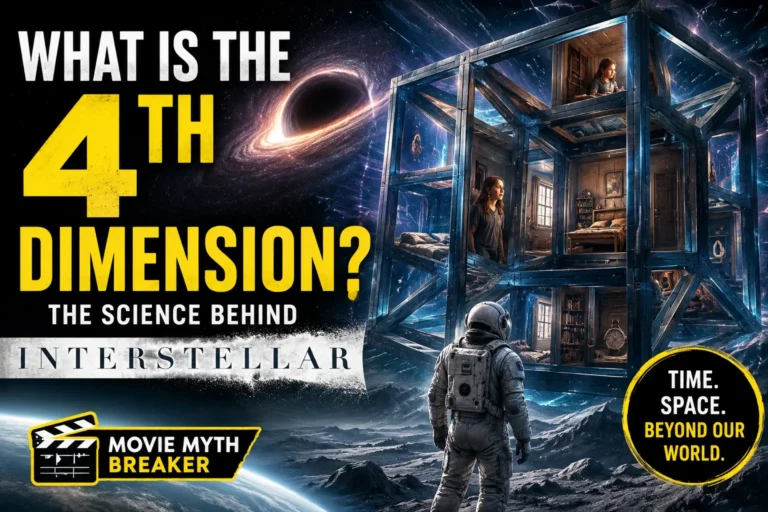
- Interstellar: In Interstellar, time travel centers on two main concepts: gravitational time dilation and a tesseract built by future humans. Astronaut Cooper travels near a massive black hole, causing time to pass much slower for him than on Earth, ultimately allowing him to traverse time and save humanity.
- Tenet: In Christopher Nolan’s Tenet, time travel is portrayed through “time inversion” rather than jumping to different eras. A secret agent known as The Protagonist learns that scientists in the future invented machines that reverse the entropy of people and objects, forcing them to experience time backward.
4. What Is Time According to Physics?
In physics, time is considered the fourth dimension, combined with the three dimensions of space to form space-time. Unlike our everyday experience, time does not flow at the same rate for everyone. According to Albert Einstein’s Theory of Relativity, the passage of time depends on an object’s speed and the strength of gravity. This means that time can slow down or speed up relative to different observers, a phenomenon known as time dilation. This discovery forms the scientific foundation for the possibility of time travel.
Unlike a rigid cosmic clock, time behaves in two distinct ways depending on the scale:
- On a cosmic scale (Relativity): Time is elastic and relative. It slows down the faster you move through space or the closer you are to a strong gravitational pull (like a planet or black hole).
- On an everyday scale (Thermodynamics): Time is a one-way street. It only moves forward because the universe naturally moves from a state of order to disorder (a concept called entropy).
5. Einstein Changed Everything
Space Time:
According to Albert Einstein, space and time are not separate entities but are combined into a single four-dimensional structure called space-time. Every object with mass, such as a planet or star, bends this space-time fabric, much like a heavy ball placed on a stretched rubber sheet.
This curvature is what we perceive as gravity. The stronger the gravitational field, the slower time passes relative to areas with weaker gravity. Similarly, as an object’s speed approaches the speed of light, time also slows down for that object. This phenomenon is known as time dilation.
Einstein’s theory revolutionized our understanding of the universe by showing that time is flexible, not absolute. It also provides the scientific foundation for many modern ideas about time travel, wormholes, and black holes.
Relativity:
Albert Einstein’s Theory of Relativity states that space and time are relative, meaning they are not the same for every observer. The faster an object moves or the stronger the gravitational field it experiences, the more slowly time passes for that object compared to someone else.
Example: The Twin Paradox
Imagine two identical twins. One twin stays on Earth, while the other travels through space in a spacecraft moving close to the speed of light. After several years, the astronaut returns to Earth.
Although both twins experienced time normally from their own perspective, the traveling twin would be younger than the twin who remained on Earth because time passed more slowly aboard the fast-moving spacecraft. This effect is called time dilation, and it is one of the key predictions of Einstein’s Theory of Relativity.
While humans cannot yet travel fast enough to notice this effect significantly, scientists have confirmed it using highly accurate atomic clocks on fast-moving aircraft and satellites. GPS satellites also account for relativity; without these corrections, navigation errors would accumulate by several kilometers each day.
This theory shows that traveling into the future is scientifically possible through time dilation, although traveling into the past remains purely theoretical.
Time is not absolute:
Before Albert Einstein, scientists believed that time was absolute, meaning it flowed at the same rate everywhere in the universe. Einstein’s Theory of Relativity challenged this idea by showing that time is relative—its passage depends on an observer’s speed and the strength of gravity.
For example, a clock aboard a spacecraft traveling close to the speed of light will tick more slowly than an identical clock on Earth. Likewise, a clock placed near a massive object like a black hole will run slower than one far away from its gravitational pull. This phenomenon is called time dilation.
In simple terms, Einstein proved that there is no universal clock for the entire universe. Time can pass at different rates for different observers, making it a flexible part of the space-time fabric rather than a constant quantity.
6. Time Dilation: Real-Life Time Travel
- International Space Station: Time Dilation on the International Space Station

- One of the best real-world examples of time dilation occurs aboard the International Space Station. The station orbits Earth at about 28,000 km/h (17,500 mph), causing astronauts to experience special relativistic time dilation—their clocks run slightly slower than clocks on Earth because of their high speed.
- At the same time, the ISS is farther from Earth’s center, where gravity is slightly weaker. According to general relativity, weaker gravity causes time to pass slightly faster. However, the slowing effect due to the station’s high speed is larger than the speeding effect from weaker gravity.
- As a result, astronauts on the ISS age very slightly more slowly than people on Earth. The difference is tiny—only a few milliseconds over several months—but it has been measured with highly accurate atomic clocks and confirms Albert Einstein’s Theory of Relativity.
- This means that astronauts on the ISS are technically traveling into the future, albeit by an extremely small amount.
- GPS satellites: Time dilation is not just a theory—it is a real phenomenon that engineers must account for in the Global Positioning System (GPS).
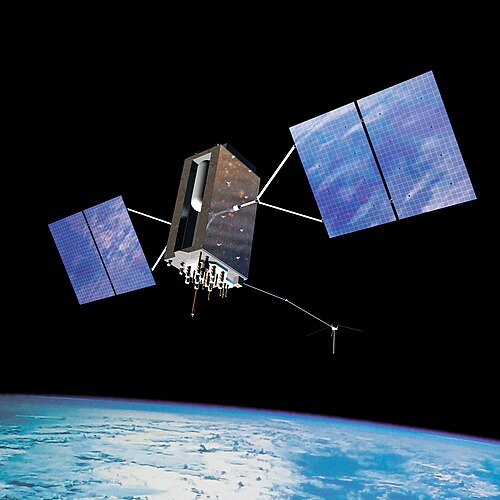
- GPS satellites orbit Earth at an altitude of about 20,200 km and travel at nearly 14,000 km/h. According to Albert Einstein’s Theory of Relativity, two effects influence the satellite’s clocks:
- Special Relativity: Because the satellites are moving at high speed, their clocks run about 7 microseconds slower per day than clocks on Earth.
- General Relativity: Because the satellites are much farther from Earth’s gravity, their clocks run about 45 microseconds faster per day.
- The net effect is that GPS satellite clocks run about 38 microseconds faster each day than clocks on Earth. Although this difference is tiny, if it were not corrected, GPS navigation errors would grow by about 10 kilometers every day.
- This everyday technology provides one of the strongest practical proofs that time dilation is real and that Einstein’s Theory of Relativity accurately describes how time behaves.
7. Can Black Holes Slow Time?
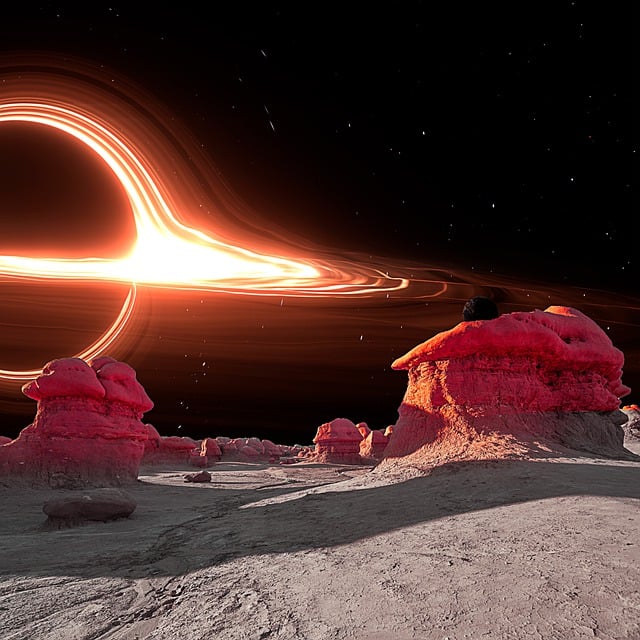
According to Albert Einstein’s General Theory of Relativity, gravity doesn’t just pull objects—it also affects the flow of time. The stronger the gravitational field, the more slowly time passes. This phenomenon is known as gravitational time dilation.
A black hole has the strongest gravitational field in the universe. Near its boundary, called the event horizon—the point beyond which nothing, not even light, can escape—gravity becomes so intense that time slows dramatically compared to someone far away. To a distant observer, a clock near the event horizon appears to tick more and more slowly.
A famous example of this concept appears in Interstellar. The astronauts visit Miller’s Planet, which orbits the supermassive black hole Gargantua. Because of Gargantua’s immense gravity, one hour on the planet is equivalent to about seven years on Earth. While this time difference was exaggerated for cinematic effect, it is based on real physics. The film’s scientific advisor, Kip Thorne, ensured that the depiction remained consistent with Einstein’s equations as much as possible.
Although we cannot safely approach a black hole, gravitational time dilation has been experimentally confirmed on Earth using atomic clocks and is routinely corrected for in GPS satellites. This makes black holes one of the most fascinating examples of how gravity can bend not only space but also time itself.
8. Wormholes: Theoretical Shortcuts Through Space-Time

- Einstein-Rosen Bridge:
- An Einstein–Rosen Bridge, commonly known as a wormhole, is a hypothetical tunnel through space-time proposed by Albert Einstein and Nathan Rosen in 1935. According to their mathematical solution to Einstein’s field equations, a wormhole could connect two distant points in space—or even two different points in time.
- Imagine folding a sheet of paper so that two distant dots touch each other. Instead of traveling across the entire sheet, you could simply punch a hole through it to move instantly between the two points. A wormhole works in a similar way, acting as a shortcut through the fabric of space-time.
- In theory, if one end of a wormhole experienced time differently than the other because of high speed or intense gravity, it might function as a time machine, allowing travel between different moments in time.
- However, no wormholes have ever been observed. Scientists believe that keeping one open would require exotic matter with negative energy density—something that has never been discovered in the quantities needed. As a result, Einstein–Rosen Bridges remain a fascinating theoretical concept rather than a practical method of time travel.
- Exotic matter:What Is Exotic Matter?
- Exotic matter is a hypothetical form of matter that possesses negative energy density or negative mass, giving it properties unlike any ordinary matter found in the universe. Unlike normal matter, which is always attracted by gravity, exotic matter could theoretically produce a repulsive gravitational effect.
- Physicists believe that if wormholes (Einstein–Rosen Bridges) exist, they would naturally collapse almost instantly under their own gravity. Exotic matter could, in theory, provide the outward pressure needed to keep a wormhole open and stable, allowing objects—or even people—to pass through it.
- Although small quantum effects, such as the Casimir Effect, demonstrate behavior similar to negative energy under very specific conditions, scientists have never discovered or created enough exotic matter to stabilize a wormhole.
- For now, exotic matter remains a theoretical concept and one of the biggest obstacles to building a real time machine.
- Stability challenges: Stability Challenge of Wormholes
- One of the biggest challenges in building a wormhole is stability. According to current theories, a wormhole would be extremely unstable and would collapse almost instantly after forming, leaving no time for anything to pass through it.
- To keep a wormhole open, scientists believe it would require exotic matter with negative energy density to counteract the immense gravitational forces trying to close it. However, no known material has these properties in the required amounts.
- In addition, even tiny disturbances—such as radiation, nearby matter, or a spacecraft attempting to enter the wormhole—could cause it to collapse. Until scientists discover a way to create and stabilize wormholes, they remain a fascinating mathematical concept rather than a practical means of time travel.
9. Can We Travel Into the Past?
While Einstein’s Theory of Relativity suggests that traveling into the future is possible through time dilation, traveling into the past remains one of the greatest mysteries in physics. The biggest obstacle isn’t just technology—it’s causality, the principle that every cause must occur before its effect. Traveling to the past could violate this fundamental rule and create logical contradictions known as time travel paradoxes.
Grandfather Paradox:
The Grandfather Paradox asks: What would happen if you traveled back in time and prevented your grandfather from having children before your parent was born? If your parent was never born, then you would never exist. But if you never existed, who traveled back in time to change the past? This creates a logical contradiction with no clear solution.
Bootstrap Paradox
The Bootstrap Paradox occurs when an object or piece of information exists without any clear origin. Imagine you travel to the past with a copy of a famous scientific book and give it to its original author. The author later publishes the same book, which you eventually take back in time. In this loop, the book exists, but who actually wrote it? Its origin becomes impossible to determine.
Causality: The Biggest Challenge
These paradoxes arise because they violate causality, the fundamental principle that a cause must always come before its effect. If effects could influence their own causes by changing the past, the logical order of events would break down. For this reason, many physicists believe that nature may prevent backward time travel altogether, or that any journey to the past would occur in an alternate timeline where the original history remains unchanged.
Although theories involving wormholes and quantum physics hint that backward time travel might be mathematically possible, there is currently no experimental evidence that humans can travel into the past.
10. Quantum Physics and Time Travel
Quantum physics explores the behavior of matter and energy at the smallest scales, where the laws of nature can seem strange and counterintuitive. Although no accepted quantum theory proves that time travel is possible, several ideas suggest that it cannot be completely ruled out.
Closed Timelike Curves (CTCs)
A Closed Timelike Curve (CTC) is a theoretical path through space-time that loops back on itself, allowing an object to return to an earlier point in time. Predicted by certain solutions to Albert Einstein’s equations, CTCs could, in theory, make backward time travel possible. However, there is no experimental evidence that such paths exist in the real universe.
Quantum Theories
Some physicists have proposed that quantum mechanics might help resolve time travel paradoxes. One idea is the Many-Worlds Interpretation, which suggests that traveling to the past would create or enter an alternate timeline instead of changing your own history. Another proposal, the Novikov Self-Consistency Principle, argues that any actions taken by a time traveler were always part of history, preventing paradoxes such as the Grandfather Paradox.
These ideas remain theoretical and have not been experimentally verified.
Current Limitations
Despite decades of research, quantum physics has not provided a practical way to build a time machine. Scientists face several major challenges:
- No evidence that Closed Timelike Curves exist.
- No method to create or stabilize wormholes.
- No experimental proof that backward time travel is possible.
- Quantum gravity—the theory needed to unite quantum mechanics with general relativity—has not yet been discovered.
For now, quantum physics keeps the possibility of time travel open in theory, but there is no technology or scientific evidence that would allow humans to travel through time.
11. Biggest Challenges in Building a Time Machine
Although modern physics suggests that time travel may be theoretically possible under certain conditions, building a real time machine faces enormous scientific and engineering challenges.
1. Enormous Energy Requirements
Most time travel concepts, such as wormholes or space-time manipulation, would require astronomical amounts of energy—far beyond anything humanity can currently produce. Some theoretical models suggest that energy comparable to that of an entire star or even a galaxy might be needed to create and stabilize a wormhole.
2. Exotic Matter
Many wormhole models require exotic matter with negative energy density to keep the wormhole open. While small quantum effects hint that negative energy may exist under special conditions, scientists have never discovered or produced enough exotic matter to make a stable, traversable wormhole.
3. Deadly Radiation
Regions near black holes or hypothetical wormholes are expected to contain extremely intense radiation and powerful gravitational forces. These environments could destroy spacecraft, damage electronics, and expose travelers to lethal levels of radiation long before they reached their destination.
4. Engineering Constraints
Even if the laws of physics allowed time travel, the engineering challenges would be overwhelming. Scientists would need to create materials capable of withstanding extreme gravity, precisely control the structure of space-time, and build technologies far beyond our current capabilities. At present, no known engineering method can achieve these requirements.
These challenges explain why, despite decades of research, a practical time machine remains a fascinating theoretical concept rather than a real-world invention.
12. What Do Scientists Actually Think About Time Travel?
Albert Einstein
Einstein never claimed that humans could build a time machine, but his Theory of Relativity showed that time is not absolute. His work proved that time can slow down due to high speeds and strong gravitational fields, making travel into the future through time dilation scientifically possible. However, his equations do not provide a practical method for traveling into the past.
Stephen Hawking
Stephen Hawking was skeptical about backward time travel. He proposed the Chronology Protection Conjecture, suggesting that the laws of physics may prevent events that create time paradoxes. Hawking famously joked that if time travel to the past were possible, we would already have seen visitors from the future.
Kip Thorne
Kip Thorne has extensively studied black holes and wormholes. He suggested that wormholes might theoretically be used as time machines if they could be kept open with exotic matter. While he considers the mathematics plausible, he emphasizes that there is no experimental evidence that such wormholes exist or can be engineered.
Scientific Consensus
Most physicists agree that traveling into the future is supported by Einstein’s theory and has been experimentally confirmed through time dilation. However, traveling into the past remains purely theoretical, with no experimental evidence or technology capable of making it possible. Time travel continues to be an active area of research, but for now, it belongs more to the realm of theoretical physics than practical engineering.
13. Verdict: Can We Build a Time Machine?
Can we build a time machine today?
Probably not.
Current science does not have the technology, energy, or understanding needed to manipulate space-time or create stable wormholes. Concepts like exotic matter and backward time travel remain purely theoretical.
Can physics completely rule it out?
Not yet.
Einstein’s Theory of Relativity has already proven that travel into the future is possible through time dilation. However, traveling into the past has never been observed and remains one of the biggest mysteries in physics.
So, while a real time machine is beyond our reach today, science hasn’t closed the door completely. That’s what makes time travel one of the most fascinating unsolved questions in modern physics.
14. Frequently Asked Questions (FAQ)
1. Is time travel possible?
Yes—but only to a limited extent. According to Albert Einstein’s Theory of Relativity, traveling into the future through time dilation is scientifically possible. However, traveling into the past has never been demonstrated.
2. Has anyone traveled through time?
Technically, yes. Astronauts aboard the International Space Station and GPS satellites experience tiny amounts of time dilation, meaning they move slightly further into the future than people on Earth.
3. Can black holes create time travel?
Black holes can significantly slow the passage of time because of their intense gravity. While this allows time to pass more slowly for someone nearby, there is no evidence that black holes can send people into the past.
4. Can wormholes exist?
Wormholes are mathematical solutions to Einstein’s equations and could theoretically connect distant points in space-time. However, no wormhole has ever been observed, and their existence remains unproven.
5. Could we visit dinosaurs?
With today’s science, no. There is no known technology that allows humans to travel millions of years into the past.
6. Why can’t we change the past?
Changing the past could create logical contradictions such as the Grandfather Paradox, violating the principle of causality. Many physicists believe the laws of nature may prevent such paradoxes.
7. Which movie has the most scientifically accurate time travel?
Among popular films, Interstellar is widely regarded as one of the most scientifically accurate. Its depiction of gravitational time dilation near the black hole Gargantua was based on calculations by physicist Kip Thorne.
7. Which movie has the most scientifically accurate time travel?
Among popular films, Interstellar is widely regarded as one of the most scientifically accurate. Its depiction of gravitational time dilation near the black hole Gargantua was based on calculations by physicist Kip Thorne.